Your washing machine finishes its cycle. The laundry comes out smelling clean. You fold the sheets, make the bed, and assume the job is done.
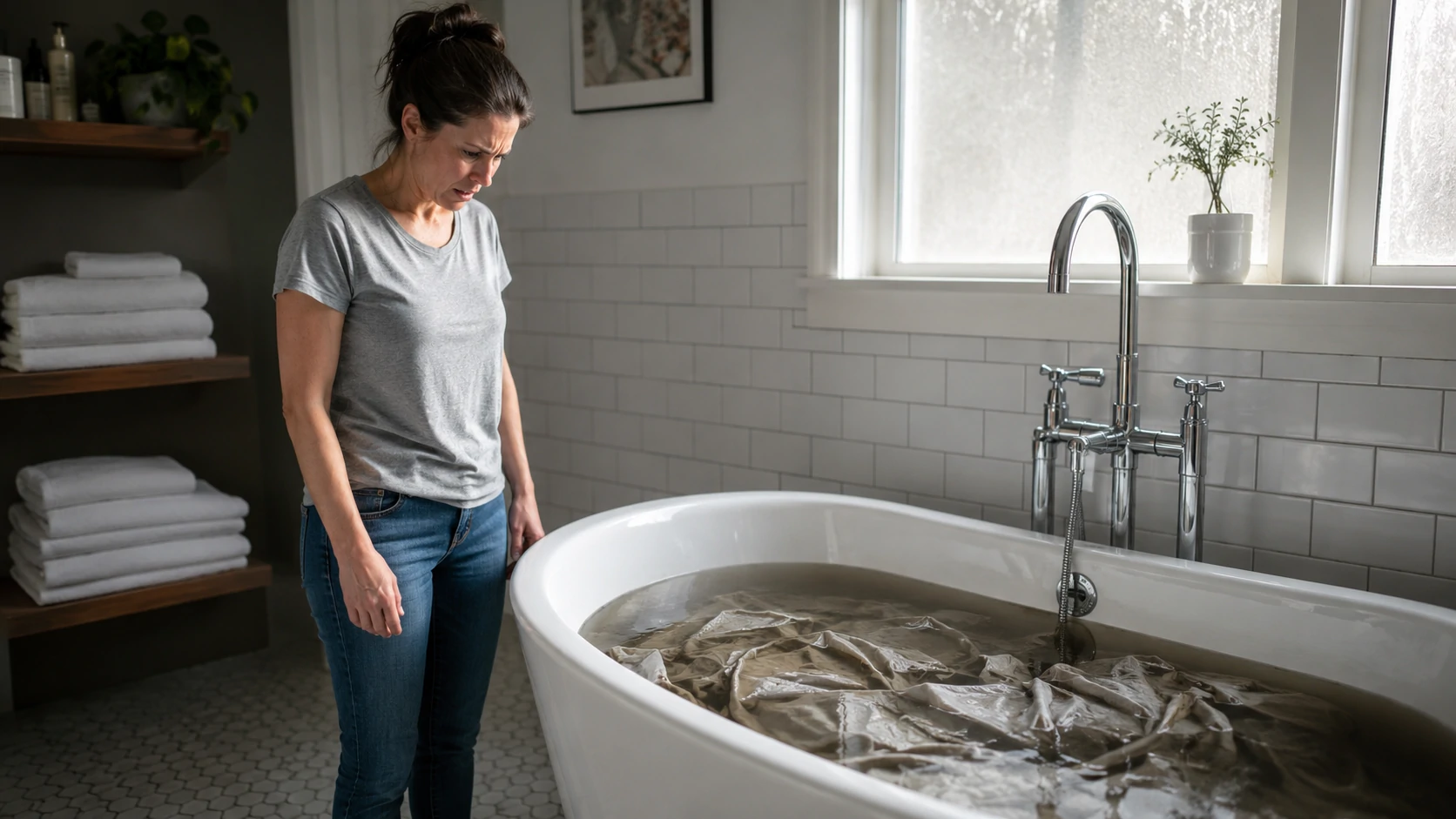
Then one day — maybe prompted by something you saw online, maybe out of curiosity — you drop those same sheets into a bathtub of hot water. Within twenty minutes, the water is grey-brown. Not faintly. Visibly, undeniably grey-brown.
And the sheets went in looking clean.
That moment is the washing machine’s lie made visible. The cycle ran. The timer counted down. The machine did everything it was supposed to do. What it couldn’t tell you was the condition of the water it was running your laundry through, or how much of what it was supposed to remove it actually left behind.
A completed wash cycle and a clean wash cycle are not the same thing. Once you understand the difference, a lot of frustrating laundry problems start making sense.
Quick answer: Washing machines appear to clean laundry while recirculating water through a drum that is often contaminated with biofilm, mold, and detergent residue. Low wash temperatures prevent true cleaning — especially for bedding. The machine runs successfully and still fails hygienically. Restoring genuine performance requires a full deep clean, correct detergent dosing, and a consistent maintenance routine.
Quick takeaways:
- Biofilm inside the drum means the machine recirculates bacteria-laden water through every wash cycle
- Excess detergent leaves sticky residue in fabric fibers that attracts and traps dirt over time
- Cold and low-temperature washes cannot dissolve body oils, kill bacteria, or disrupt biofilm
- The rubber door seal is the most overlooked source of mold contamination in front-load machines
- Sheets and towels accumulate residue that drum washing routinely misses — periodic hot soaking releases what the machine cannot
- A completed wash cycle is not the same as a clean wash cycle
The False Clean — What Is Really Happening After the Cycle Ends
Let’s start with the uncomfortable part.
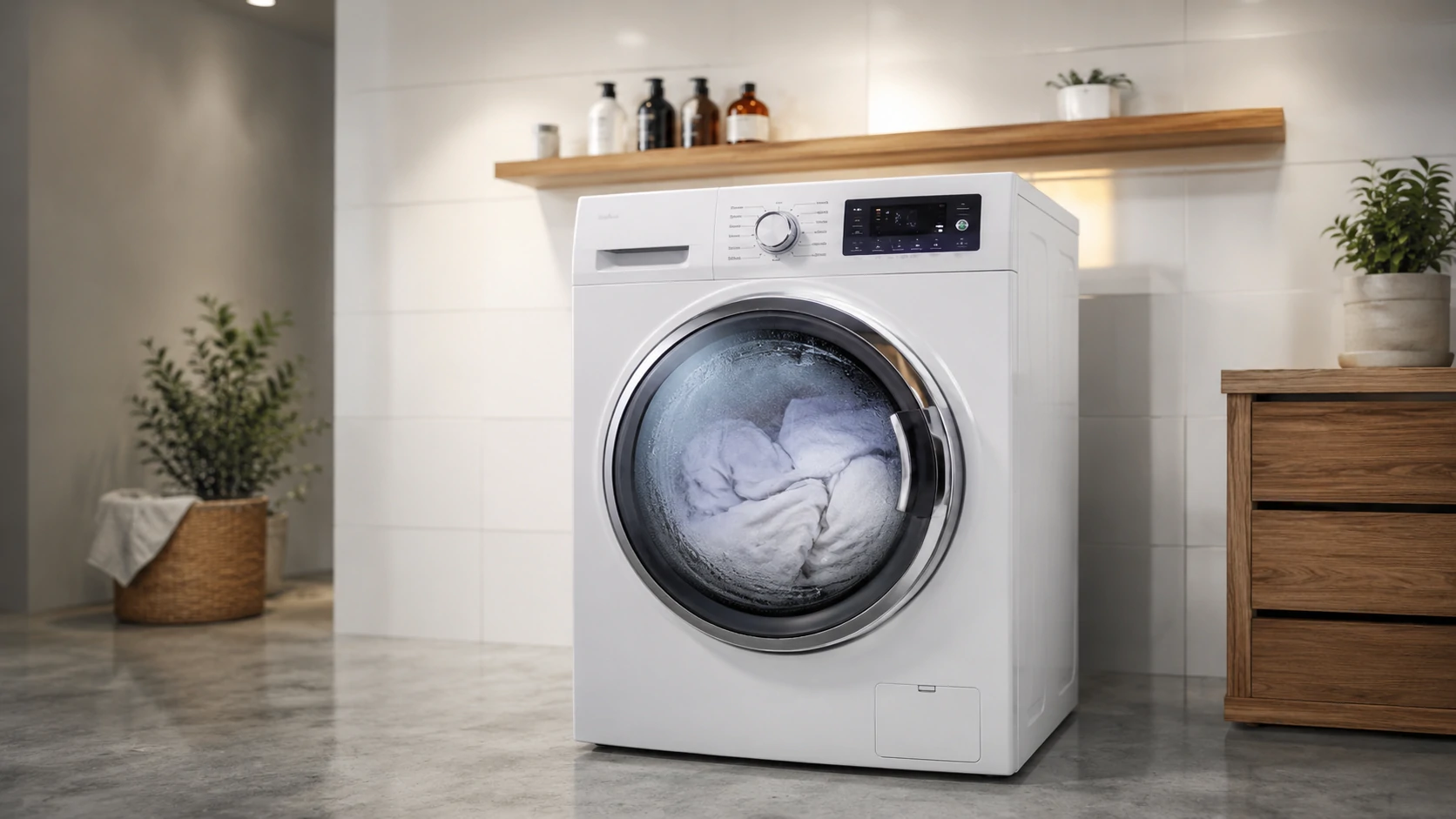
Your washing machine doesn’t rinse laundry in fresh, clean water. It recirculates the same water — repeatedly — through a drum that may be coated in biofilm, mold, mineral deposits, and months of accumulated detergent residue. That water passes over the door seal, through the drain system, and around surfaces that haven’t been properly cleaned in years. Possibly ever.
The drum spins. The laundry tumbles. The cycle ends. The machine presents the result as clean because that’s what the programme promised.
What actually happened is more complicated.
Think of it this way: washing laundry in a contaminated drum is roughly equivalent to washing dishes in water that hasn’t been changed in months and assuming the soap bridges the gap. The soap helps. The machine runs. But the baseline it’s working from is not clean to begin with.
Freshly washed laundry often smells fine straight out of the machine. The heat of the dryer, or moving air if you line-dry, temporarily masks the problem. It’s only later — when sheets warm against skin overnight, or towels dampen after a shower — that the stale, musty undertone returns. That’s the drum’s contamination completing a transfer that the wash cycle started.
The machine didn’t malfunction. It ran exactly as designed. The design just has limits that routine maintenance is supposed to address — and usually doesn’t.
What Is Biofilm and Why Does It Survive Your Wash Cycles?
Most people assume visible mold on the door seal is the primary problem. The mold is a problem. What’s often doing more damage, silently, is something you cannot see at all.
Biofilm is not the same as mold. This distinction matters because the fix is different.
Mold is a visible fungal growth. It’s localized, surface-level, and identifiable. You can see it. You can wipe it. It’s unpleasant but relatively straightforward to address.
Biofilm is something else entirely. It’s a self-organizing colony of bacteria that encases itself in a protective matrix of polysaccharides — a sticky, gel-like substance the bacteria produce specifically to shield themselves from environmental threats. Those threats include detergent, mechanical disruption, and temperature changes. The polysaccharide matrix is not removed by standard washing and is not visible during casual inspection.
Inside a washing machine drum, biofilm forms on every surface where moisture, warmth, and organic material coexist: the drum walls, the door seal interior, the drainage system, and the recessed edges of the drum paddles. Once established, it doesn’t wash away. Standard detergent at 30–40°C deflects off the polysaccharide matrix rather than penetrating it.
Here’s the part that most people don’t realize: low-temperature washes don’t just fail to remove biofilm — they accelerate its development.
The bacteria that produce biofilm thrive in the warm, moist conditions of a 30–40°C wash cycle. Every moderate-temperature wash provides ideal growing conditions and a fresh supply of organic material — body oils, dead skin cells, detergent residue — for the colony to feed on.
Breaking biofilm requires sustained heat above 60°C, contact with an oxidizing cleaning agent (oxygen bleach, citric acid), or both. A 40°C cycle with a standard cleaning tablet provides neither. It’s why households that run drum clean cycles and see temporary improvement find the problem returning within weeks — the colony was never broken down thoroughly enough to prevent re-establishment.
The Detergent Paradox — How Using More Creates More Dirt
This mistake is almost universal, and it makes complete intuitive sense. Laundry isn’t coming out clean. The logical fix is more detergent. More cleaning agent, more cleaning power.
Except the opposite happens. Over months of overdosing, the underlying problem gets measurably worse.
Here’s the mechanism.
Detergent contains surfactants — molecules that lift soil from fabric and hold it in suspension in the wash water. But surfactants only work effectively when the water volume is sufficient to rinse them out completely during the final cycles. When the dose exceeds what the load and water volume can rinse away, the excess stays behind. It settles into fabric fibers as a residue film.
That residue is hygroscopic — it attracts and holds moisture. It’s also adhesive. Body oils, bacteria, skin cells, and mineral deposits from hard water all bind to it. The fiber that was supposed to come out clean now has a layer of sticky surfactant residue actively collecting the next round of soil before the laundry even goes back on the bed.
Repeat that process weekly for a year. What you end up with is bedding that feels slightly stiff, looks slightly grey, smells fresh when newly washed and stale within hours — because the residue layer is acting as a continuous soil trap that the machine’s standard cycle can no longer clean through.
High-Efficiency machines make this significantly worse. HE washers use considerably less water per cycle by design — a meaningful reduction in water consumption, but also a concentration risk. Detergent dosed for a standard-fill machine is too concentrated for an HE drum that uses a fraction of the water. The surfactant concentration per litre of wash water increases, the residue deposition per cycle increases, and the cumulative buildup compounds faster than it would in an older top-loader.
Appliance technicians who work on HE machines commonly find detergent residue buildup that’s measurably worse than in equivalent front-loaders with comparable usage — and many recommend using 50–75% of the marked detergent dose for HE cycles, particularly in areas with soft water where surfactants don’t need to compete with mineral hardness.
The correction is counterintuitive: use less detergent, not more. In hard water areas, the correct addition is a water softener or a dedicated hard water laundry product — not an increased detergent dose.
The Five Places Your Machine Is Actually Dirty
Running a drum cleaning tablet once a quarter and calling it done misses four of the five locations where contamination actively lives. Here’s where to look — and what to expect when you do.
1. The Door Gasket — The Fold Nobody Opens
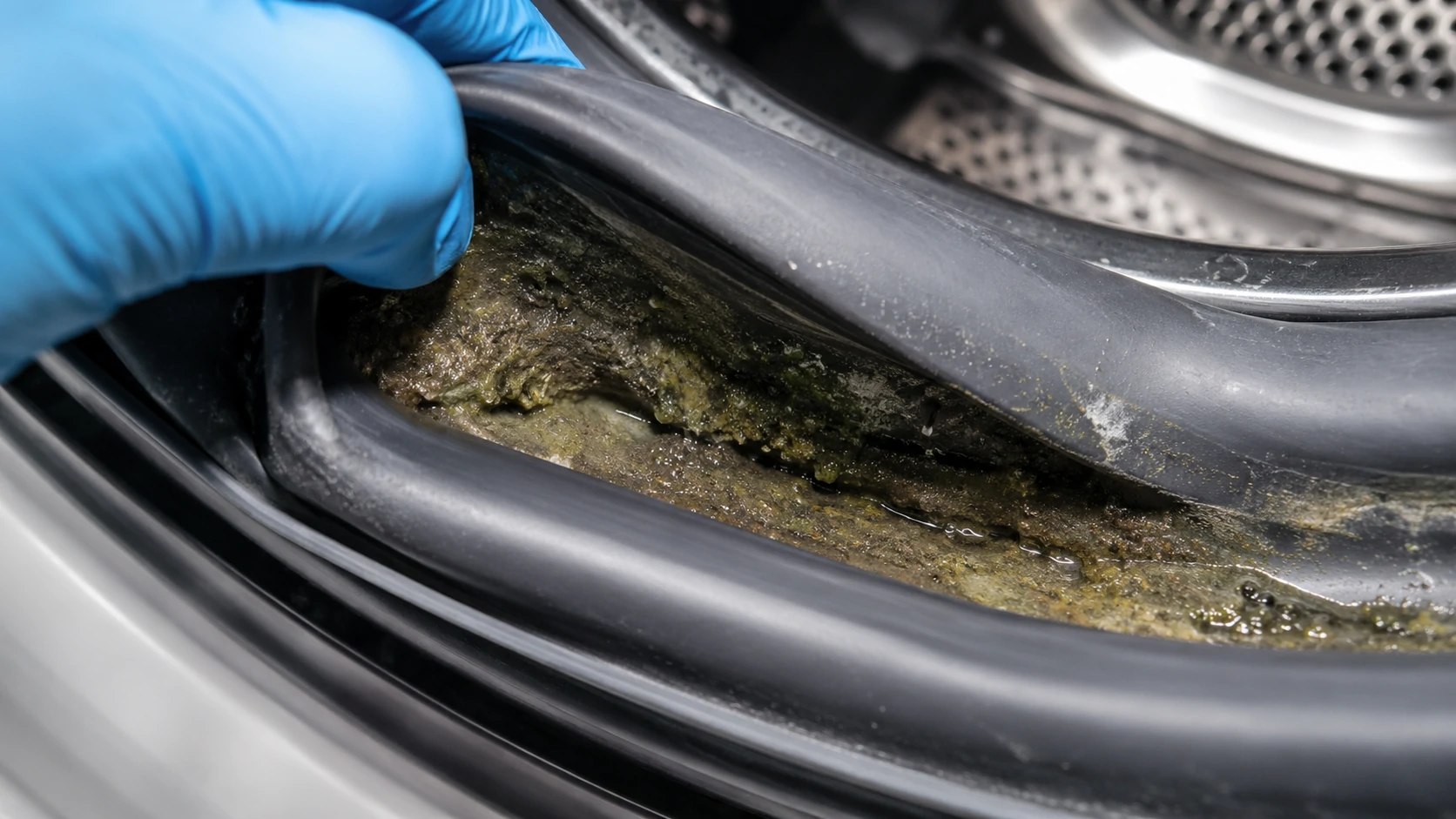
The rubber seal around a front-loader door has an inner fold that most people never access during cleaning. That fold sits below the water line during a wash cycle and traps standing water between uses. Inside that fold: residual detergent, lint, hair, and the perpetual warm moisture that mold needs to establish itself.
Inspection records on older front-loaders consistently document active mold colonies in the gasket fold that are not visible from outside the door. When the machine runs, that mold is in direct contact with every load passing through.
Proper cleaning requires pulling the fold back manually all the way around the circumference — not just wiping the visible outer surface. A door left closed between washes traps moisture and creates ideal mold conditions with every cycle. This is one of the simplest single habits to change.
2. The Detergent Drawer — and the Tube Inside It
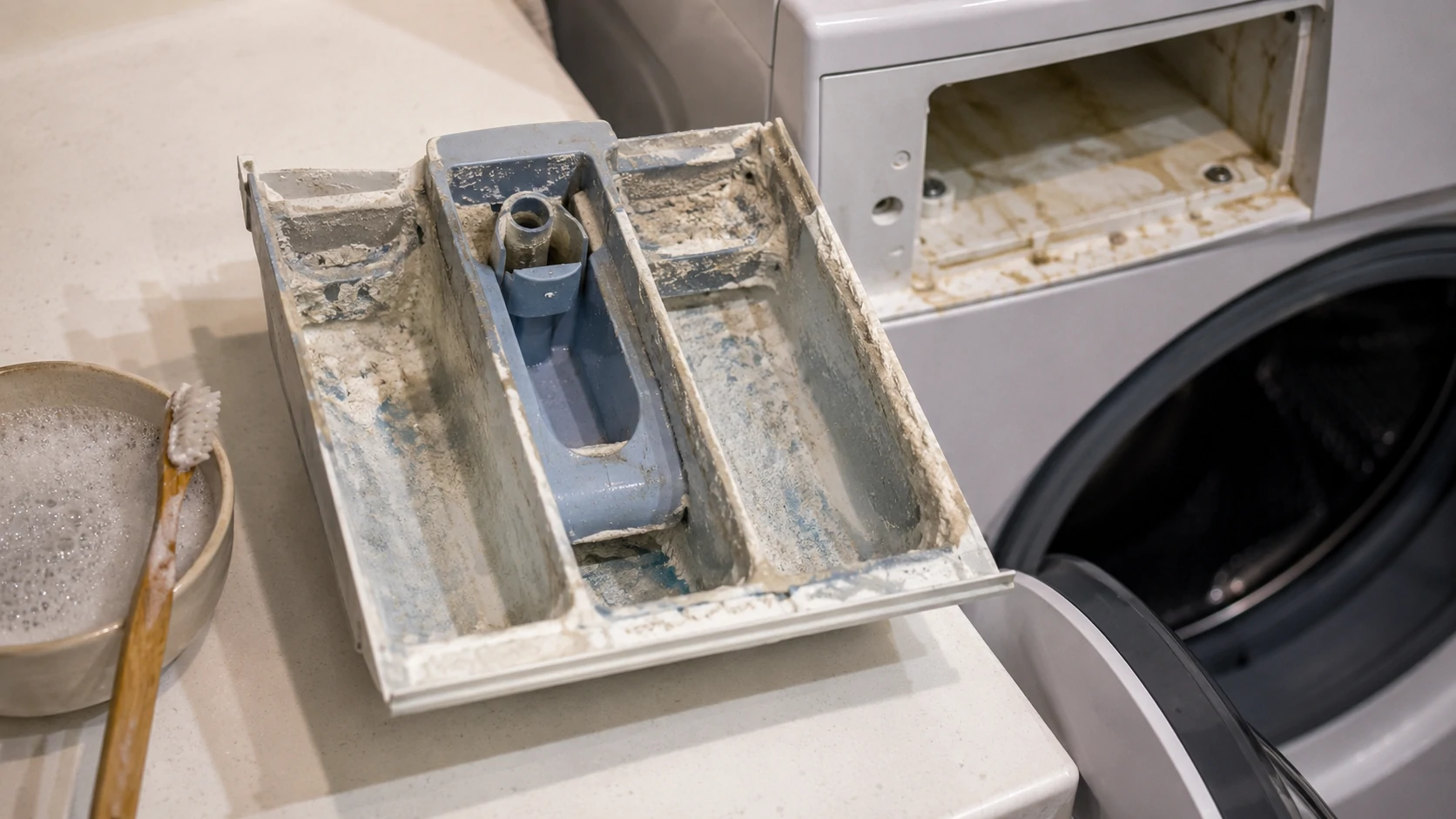
Most people occasionally rinse the detergent drawer under a tap. Very few remove it fully. Almost no one looks at the internal siphon tube — the small pipe inside the drawer compartment that controls water flow into the drawer during the cycle.
That siphon tube develops mold colonies in the same conditions as the door seal. The difference is that when it drips, it drips directly into the drawer, and from the drawer into the drum — meaning every wash cycle begins with active contamination entering the load before the cycle has even properly started.
The drawer cavity inside the machine (the slot the drawer slides into) is also routinely ignored. It collects detergent overflow and is rarely wiped between uses. Both the drawer and the cavity need attention.
3. Drum Paddles — The Recess Edges
The raised paddles inside the drum create the tumbling action. Their outer edges contain recessed channels where fabric residue, limescale, and biological buildup accumulate over time. A drum that looks clean from the doorway can have significant buildup in those paddle recesses that a drum clean cycle only partially addresses.
4. The Drain Filter — The One Most People Have Never Touched
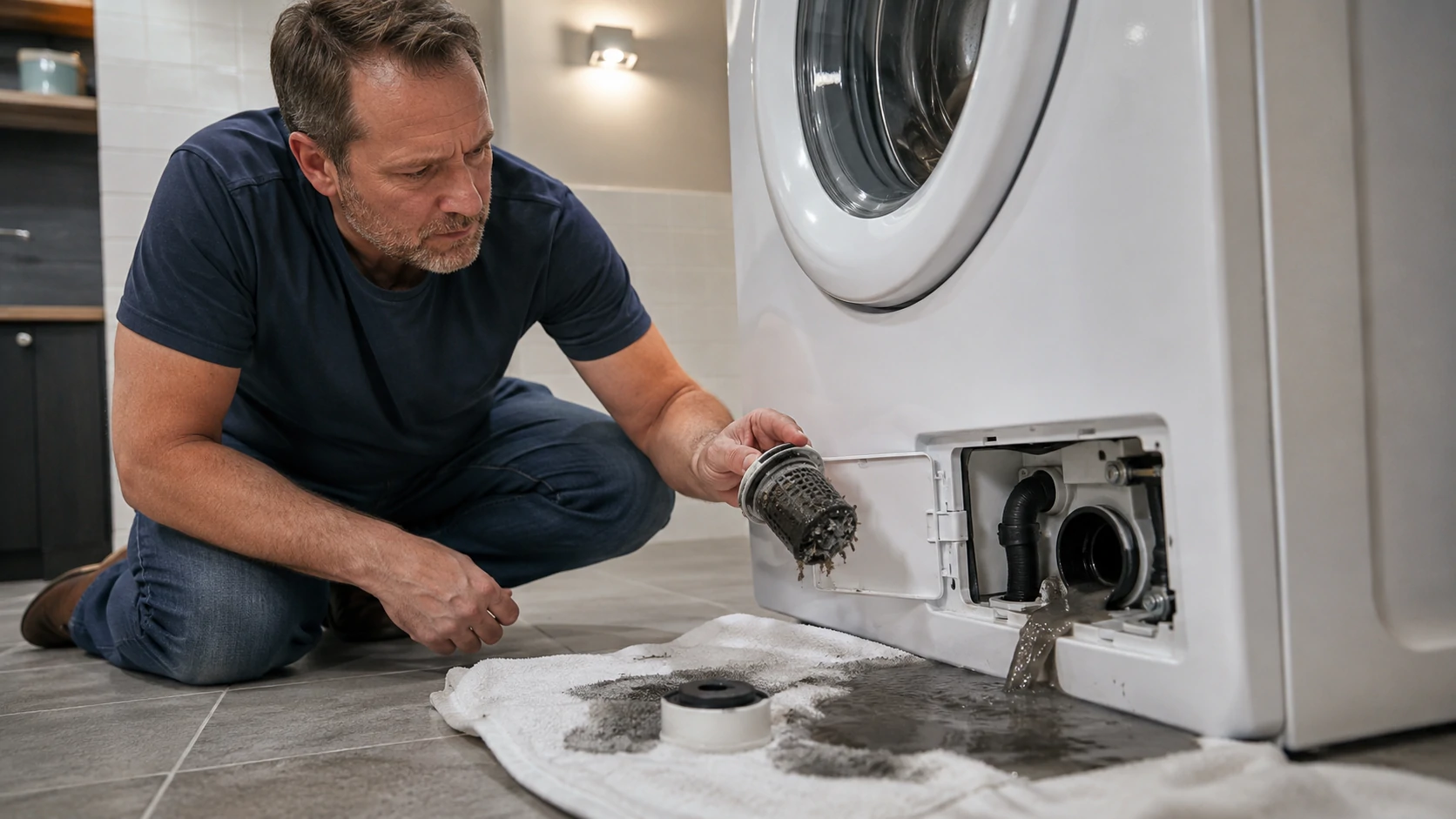
This is the single most neglected component in a residential washing machine. On front-loaders it’s typically located behind a small access panel at the base of the machine — sometimes disguised as a decorative kick panel.
Inside the filter: lint, hair, small objects from pockets, and standing water from the most recent cycle. That water goes stale quickly. In a machine that recirculates water through the same drainage system, a clogged or contaminated filter sends re-contaminated water back through the drum with each cycle.
Appliance service records regularly show drain filters full of months or years of accumulated debris in machines brought in for odour complaints. Cleaning the filter — removing it, clearing the debris, rinsing it, reinstalling it — often resolves persistent odour that repeated drum clean cycles have not touched.
It should be cleaned every three months. Most homeowners clean it never.
5. The Water Inlet Filter Screen
The small mesh screen inside the water inlet hose connection at the back of the machine is a limescale accumulation point in hard water areas. Partial restriction of the inlet flow means the drum doesn’t fill to its designed water volume. For an HE machine already operating with reduced water, inlet restriction further increases detergent concentration and reduces rinsing effectiveness — without triggering any visible error or alarm.
Why Sheets and Bedding Are a Different Problem Entirely
Clothing and bed linen are not the same cleaning challenge. A t-shirt worn for a day carries a fraction of the soil load that a set of sheets accumulates in a week of use. And the drum handles them very differently — to the sheets’ consistent disadvantage.
Bedding carries a heavy load of body oils (sebum), perspiration salts, dead skin cells, and — particularly for allergy sufferers — dust mite debris and allergen material. These compounds bind into cotton fibers at a molecular level. Releasing them requires hot water, extended contact time, and full fabric immersion.
A washing machine drum provides none of these reliably for large items.
A king-size duvet cover in a drum doesn’t tumble freely. It folds over itself, compressing the inner layers and preventing water penetration through to the center. The outer surface gets thoroughly wet. The inner folds stay partially dry. The sheet circulates through the drum rather than soaking through — the machine runs a full cycle, but the interior fibers of the sheet had intermittent water contact at best.
Compare that to dropping those same sheets into a bathtub of hot water and pushing them fully under. Within twenty minutes the water changes color. What releases into the water is what the machine left behind across multiple washes: body oils, surfactant residue, mineral deposits from hard water, and biological debris embedded in the fiber structure.
The grey-brown water is not a sign of poor hygiene. It is a physics outcome. The drum washing cycle completed as designed — it just cannot replicate the penetration that a full immersion hot soak achieves for large, high-soil-load items. Understanding this explains both why the bathtub discovery produces such a striking result, and why bedding genuinely requires a supplementary approach that machine washing alone doesn’t cover.
What Is Strip Washing — And Did Your Bathtub Just Prove It Works?
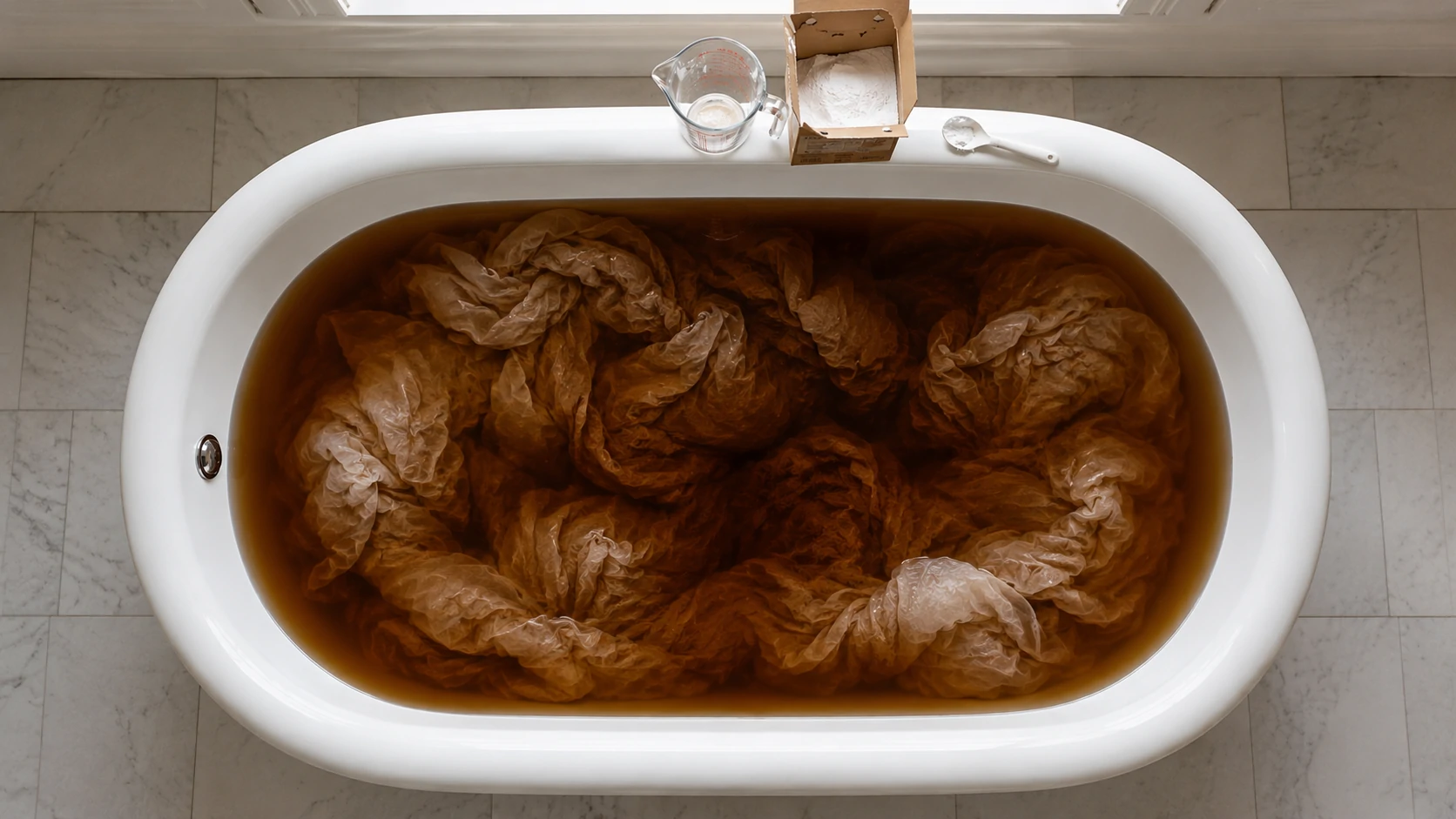
If you discovered strip washing through social media, you’ve likely seen the videos: clean-looking sheets dropped into a bathtub, the water turning dark brown within an hour, the comments full of people who had the same reaction to the same experience. That grey-brown water is real. It isn’t exaggerated for content. If it happened to you, your instinct — that something was being released that the machine had missed — was correct.
What strip washing actually does: It uses a high-alkalinity hot water solution to break the bonds between accumulated residue and fabric fibers. The residue releases into the water — surfactant buildup, mineral deposits, body oils, and in some cases years of fabric softener coating. That’s the discoloration. The laundry comes out genuinely cleaner than it went in, even when it appeared visually clean before the soak began.
The Correct Strip Wash Method
Fill a bathtub (or large clean bucket) with the hottest water the fabric tolerates — for cotton sheets, that typically means as hot as the tap will run, or water from the kettle cooled slightly. Then dissolve into it:
- ¼ cup washing soda (sodium carbonate — not baking soda, which is milder sodium bicarbonate)
- ¼ cup borax substitute (sold in most supermarkets and hardware stores)
- ½ cup powdered laundry detergent (powder performs better here than liquid — higher pH, less foam)
Stir until fully dissolved. Submerge the laundry, push it fully under, and leave it for 4–6 hours — stirring occasionally if convenient. Drain, rinse thoroughly, then run through a standard machine rinse cycle to remove any remaining solution.
Important — dishwasher detergent on laundry: Some homeowners discover strip washing by accident when using dishwasher detergent to soak laundry — either out of curiosity or because it was at hand. It produces a visually similar result: the water discolors, the residue appears to release. But dishwasher detergent is formulated for hard, non-porous surfaces. It contains higher alkalinity levels and enzymes designed to strip baked-on food residue from ceramics, not to release body oils from cotton fiber. Used on laundry, it can cause fiber degradation in delicates, discoloration in dyed fabrics, and skin irritation from chemical residue that remains in the weave after rinsing. For fabric-safe strip washing, the washing soda, borax substitute, and powdered laundry detergent combination above is the appropriate method.
Strip washing is not a replacement for regular hot machine washes. It’s a periodic reset — typically twice a year for bedding and towels — that clears the accumulated residue that machine cycles cannot fully reach.
How to Deep Clean Your Washing Machine — The Full Sequence
The most common version of a washing machine clean is running a drum tablet and considering the job finished. One product targeting one component is not a deep clean. Here’s the correct sequence — in the order that actually matters.
Step 1: Door Gasket — Inspect First, Then Clean
Pull back the inner rubber fold of the door seal all the way around the circumference. Look for visible mold (black or dark grey patches), slime deposits, or significant residue accumulation in the fold interior.
For light mold and residue: Wipe with a cloth soaked in a 1:1 solution of white distilled vinegar and water. Work the cloth into the full fold rather than just the outer surface.
For established mold: Use a diluted bleach solution — 1 part household bleach to 9 parts water. Apply with a cloth, leave for 10 minutes, then wipe thoroughly and rinse with a damp cloth. Do not use undiluted bleach directly on the gasket rubber; repeated direct application accelerates deterioration and shortens the gasket’s service life.
Leave the door open after cleaning and after every subsequent wash cycle.
Step 2: Detergent Drawer — Remove, Soak, and Clean the Siphon Tube
Remove the drawer completely (check the machine manual if the release mechanism isn’t obvious). Soak it in a basin of hot water for 20–30 minutes. Use an old toothbrush to clean the siphon tube and all compartment edges thoroughly. While the drawer is out, wipe down the cavity inside the machine that the drawer slides into — it collects detergent overflow and is almost always overlooked. Rinse everything before reinstalling.
Step 3: Drain Filter — The Step That Often Resolves the Odour
Place a towel or shallow tray under the access panel at the base of the machine before opening — water will drain out when the cap is removed. Open the cap slowly. Let the water drain. Pull out the filter, remove all debris, rinse under a tap, and reinstall. Tighten the cap fully before running the next cycle.
If the filter has clearly never been cleaned and the machine has been in use for several years, this step alone frequently resolves persistent drum odour that cleaning tablets have failed to address. The debris in a long-neglected filter can be significant.
Step 4: Drum Clean Cycle
With the drum completely empty, run the machine’s drum clean cycle — or the hottest available cycle (60°C minimum; 90°C if available). Add one of the following:
- A drum cleaning tablet (follow pack instructions)
- 250ml white distilled vinegar added to the drum directly, plus a cup of bicarbonate of soda
- An oxygen bleach powder (sodium percarbonate) — follow dosage instructions on the packet
Do not combine chlorine bleach with vinegar. The chemical reaction produces chlorine gas. Choose one approach and use it alone.
Step 5: Second Rinse Cycle
After the drum clean cycle completes, run one additional empty rinse and spin cycle. Cleaning agent residue left in the drum is a common cause of chemical smell on laundry after a drum clean — the second rinse cycle clears it before the machine is used for laundry again.
Step 6: Drying Protocol — Going Forward
Leave the drum door open and the detergent drawer pulled out after every wash from this point forward. The interior cannot dry if it’s sealed. This single habit, consistently maintained, removes the moisture conditions that allow mold and biofilm to re-establish between cycles.
What Your Temperature Dial Is Not Telling You
The temperature selected on a wash cycle dial is a target, not a guarantee.
On older machines — or machines running at the lower end of their specification — internal thermostats drift over time. A cycle set to 60°C may actually heat the water to 48–52°C. Warm enough to feel like a hot wash. Not hot enough to disrupt biofilm or reliably kill the bacteria producing it.
This explains why some homeowners run drum clean cycles on high temperature settings, see no meaningful improvement, and conclude that the cleaning product isn’t working. The product may be fine. The machine may not be reaching the temperature the product needs to work.
On machines over 7–10 years old, thermostat drift of 8–15°C below the selected setting has been documented in appliance service contexts. If multiple hot drum clean cycles have produced no consistent improvement, verifying the actual achieved water temperature with an inexpensive drum thermometer is a useful diagnostic step before assuming the contamination is structural.
| Wash Temperature | What It Actually Achieves | Best For |
|---|---|---|
| Cold / 20°C | Rinses; minimal soil removal; reduces shrinkage risk | Delicates, lightly soiled items, colorfast fabrics |
| 30°C | Light cleaning; low energy draw | Everyday clothing, synthetic fabrics |
| 40°C | General-purpose cleaning | Most clothing, moderately soiled loads |
| 60°C | Kills most bacteria; dissolves body oils; disrupts biofilm | Bedding, towels, heavily soiled items, drum clean |
| 90°C | Sanitizing; kills dust mites; removes deep residue | White cottons, hygiene items, annual maintenance wash |
On machines over 7–10 years old, thermostat drift can reduce the actually achieved drum temperature by 8–15°C below the selected setting. If drum clean cycles at 60°C produce no improvement after the full deep clean sequence, a drum thermometer test is the next step.
The Maintenance Routine That Prevents the Problem Returning
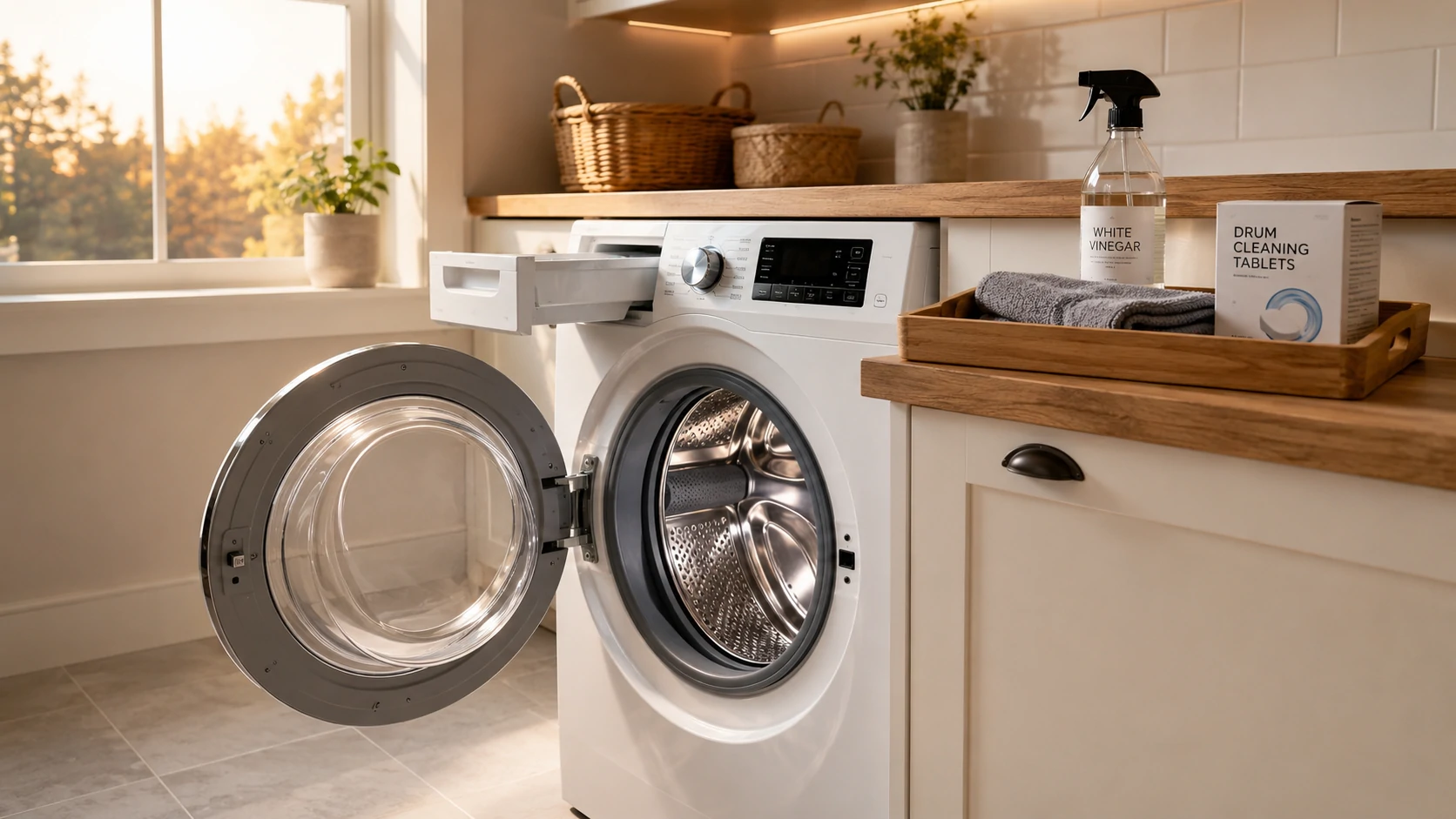
The full deep clean described above resets the machine. What keeps it there is a simple, consistent routine. Framing it as a large periodic task makes it easier to put off. In practice, the active time across all tasks in a given month is about ten minutes total.
| Frequency | Task |
|---|---|
| After every wash | Leave drum door and detergent drawer open to dry completely |
| Weekly | Wipe door seal interior fold with a damp microfiber cloth |
| Monthly | Run drum clean cycle at minimum 60°C with a cleaning product |
| Monthly | Remove detergent drawer and soak in hot water; clean siphon tube |
| Every 3 months | Clean drain filter — remove, clear debris, rinse, reinstall |
| Every 6 months | Inspect water inlet filter screen for limescale restriction |
| Annually | Run one empty 90°C maintenance wash to fully reset drum hygiene |
Two habits contribute more than anything else to long-term machine hygiene: leaving the door open after every use, and keeping the detergent dose accurate. Most ongoing contamination problems in otherwise well-maintained machines trace back to one or both of those being consistently skipped.
Troubleshooting Guide — Symptom, Cause, Fix
| Symptom | Most Likely Cause | Recommended Fix |
|---|---|---|
| Sheets smell after washing every week | Biofilm in drum; wash temperature too low | Full drum deep clean + wash bedding at 60°C minimum |
| White sheets yellowing or going grey | Detergent residue + body oil buildup in fibers | Strip wash + reduce detergent dose going forward |
| Laundry smells clean wet, stale within hours | Mold in door seal or detergent drawer | Full gasket and drawer clean; leave door open after every use |
| Stains not lifting despite multiple washes | Residue layer sealing stain into fiber | Strip wash + pre-treat stain before rewashing |
| Machine smells musty but looks clean inside | Biofilm in drum, mold in seal, clogged drain filter | Full deep clean sequence — including drain filter |
| Towels rough and no longer absorbent | Fabric softener coating fibers | Wash towels with white vinegar; eliminate fabric softener |
| Machine leaving grey marks on laundry | Dirty or residue-clogged drum paddles | Drum clean cycle + manual wipe of paddle recess edges |
| Persistent odour after drum cleaning tablet | Drain filter never cleaned; possible thermostat drift | Clean drain filter; verify actual drum temperature |
When Cleaning the Machine Yourself Is Not Enough
There’s a point at which continued self-cleaning stops being productive and becomes a delay in getting a proper diagnosis. Identifying that point matters — both for the machine’s long-term condition and for avoiding the frustration of running the same cleaning cycles without improvement.
Contact an appliance technician when:
- Persistent odour remains after the full deep clean sequence — drain filter, gasket, drawer, and drum clean all addressed — with no meaningful improvement. A sewage-type smell in particular usually indicates a drain or venting issue that cleaning products cannot resolve.
- Visible mold appears inside the drum body or behind drum paddles, rather than only on the door seal. Surface gasket mold is a maintenance issue. Mold inside the drum casing is a structural contamination problem.
- The machine is not heating water despite correct cycle selection. This indicates a thermostat or heating element failure — not a cleaning issue.
- Water remains standing in the drum after cycle completion. Incomplete drainage indicates a pump or filter blockage beyond what a standard filter clean addresses.
- The door gasket shows active deterioration — tears, permanent deformation, or discoloration that cleaning does not address. A compromised gasket cannot be cleaned back to function; it needs replacement before the damage extends to surrounding components.
- Biofilm recurs within two weeks of a thorough drum clean. Rapid recurrence suggests either the thermostat is not reaching effective cleaning temperatures, or a contamination source the clean didn’t reach — both of which warrant professional diagnosis.
Cost context: A service call in the UK typically runs £60–120 for a diagnostic and basic repair. In the US, expect $100–200 depending on location and the issue. That cost is worth weighing against the alternatives — continued ineffective washing, potential gasket replacement from prolonged mold damage, and bedding that needs replacing because years of residue accumulation have made it unrestorable through strip washing.
Frequently Asked Questions
Why do my bed sheets still smell after I wash them every week?
Persistent sheet odour after regular washing almost always points to one of three causes: a drum contaminated with biofilm recirculating bacteria-laden water through each cycle; wash temperatures too low to dissolve body oils and break down biological buildup in the fabric; or residue accumulation in the sheet fibers from excess detergent or fabric softener. The most effective reset is a full drum deep clean followed by washing bedding consistently at 60°C — not the warm or cool settings most people use by default.
What is biofilm in a washing machine and how is it different from mold?
Mold is a visible fungal growth, typically black or dark green, that develops on surfaces exposed to chronic moisture — most commonly in the door seal fold. Biofilm is an invisible bacterial colony that produces a protective polysaccharide gel matrix around itself. That matrix resists standard detergent, survives moderate-temperature wash cycles, and cannot be wiped away like surface mold. Breaking it requires sustained heat above 60°C combined with an oxidizing cleaning agent. Running a warm cycle with a tablet is not sufficient.
Why did my sheets turn the bathwater grey-brown if they came out of the machine looking clean?
The discoloration is the machine cycle’s limitations made visible. The water released body oils, perspiration salts, mineral deposits, surfactant residue from detergent buildup, and biological debris that had accumulated in the fiber structure across multiple washes. The machine completed its cycle successfully — it just couldn’t achieve full fiber penetration for a large item in drum washing conditions. The grey-brown water is not a personal hygiene failure. It is a physics outcome.
Is it safe to soak laundry in dishwasher detergent?
Dishwasher detergent is formulated for hard, non-porous surfaces and contains alkalinity levels and enzyme types not appropriate for textile fibers. It can cause fiber degradation in delicates, discoloration in dyed fabrics, and skin irritation from residue that remains in the weave after rinsing. It produces a visually similar result to a proper strip wash because the broad mechanism — breaking down residue bonds — overlaps. But for fabric-safe results, use washing soda, borax substitute, and powdered laundry detergent in hot water instead.
What is strip washing and does it actually work?
Strip washing is a hot water soaking method that uses a high-alkalinity solution — washing soda, borax substitute, and powdered laundry detergent — to break down accumulated residue, body oils, mineral deposits, and surfactant buildup in fabric fibers. The water discoloration during the soak is evidence of that residue releasing from the fabric. It works — but it’s a periodic deep reset, not a substitute for correct regular washing practices. Most people find they only need it after a prolonged period of low-temperature washing, heavy detergent use, or both.
How often should I run a drum clean cycle?
Monthly is the standard recommendation from appliance manufacturers and maintenance guidance. Households that wash frequently, live in hard water areas, or use predominantly low-temperature cycles benefit from running a drum clean every two to three weeks. The minimum to consistently prevent biofilm re-establishment is once a month at 60°C or above with an appropriate cleaning agent.
Why does my washing machine still smell after I used a drum cleaning tablet?
Drum cleaning tablets primarily address the drum interior. They don’t typically reach the drain filter, the detergent drawer siphon tube, or the door gasket fold — which are frequently the primary contamination sources for persistent odour. If a tablet hasn’t resolved the smell after two or three cycles, the next step is cleaning those components, starting with the drain filter. On older machines, thermostat drift may also mean the drum clean cycle isn’t reaching the temperature the tablet needs to be effective.
Can using too much laundry detergent actually make laundry dirtier over time?
Yes. Excess detergent that doesn’t fully rinse from fabric fibers leaves a hygroscopic, adhesive residue that attracts body oils, bacteria, and mineral deposits and binds them into the fiber structure. Laundry washed this way appears visually clean but carries a progressively increasing soil load embedded in residue that each subsequent cycle can’t fully reach. Using the correct dose — or less than instinct suggests, particularly in an HE machine — is part of breaking the cycle.
What temperature do I need to wash sheets to kill bacteria and dust mites?
60°C (140°F) is the minimum temperature consistently cited in public health and allergy guidance for killing common laundry bacteria and dust mites in bedding. A wash at 90°C provides a deeper sanitizing effect and is appropriate for white cottons and heavily contaminated items. Cold and warm washes (20–40°C) are not effective for hygiene washing of bedding regardless of the detergent used.
Why are my towels getting rougher and less absorbent even though I wash them regularly?
Fabric softener is almost always the cause. Softener works by coating fabric fibers with a silicone or ester-based film that makes textiles feel smooth. On towels, that film progressively blocks the fiber structure responsible for absorbency. The towels feel softer initially but become progressively less functional over time. The fix is to stop using fabric softener on towels entirely and run two or three hot wash cycles with a cup of white distilled vinegar in place of softener to help strip the accumulated coating.
Where is the dirtiest part of a front-load washing machine that most people never clean?
The drain filter. The door seal fold is the most visibly dirty component — but the drain filter, behind the access panel at the base of the machine, accumulates lint, hair, debris, and stagnant water from every cycle. Because it’s out of sight and requires a small amount of effort to access, most homeowners never touch it. It also has a more direct impact on drum odour than almost any other component, because the water it holds re-enters the system with each subsequent wash.
How do I clean a washing machine drain filter and how often?
Place a towel under the access panel before opening the cap — water will drain out. Open the cap slowly, let the water drain into the towel or a shallow tray, pull out the filter, remove all debris, rinse under a tap, and reinstall. Every three months is the recommended frequency for a regularly used machine. If the machine has a persistent odour that drum clean cycles haven’t resolved, cleaning the drain filter is the first diagnostic step to take.
Why does my laundry smell fine when wet but turn stale within hours of drying?
This almost always points to mold in the door seal or detergent drawer rather than a problem embedded in the fabric itself. Mold releases volatile compounds into the air as laundry dries and warms. The smell is intermittent because it’s temperature and humidity dependent — which is why it typically emerges as sheets warm against skin overnight or towels warm during use after a shower. A thorough door seal and drawer clean, combined with leaving the door open after every wash, usually resolves it.
Does fabric softener cause long-term problems in towels and bed linen?
For towels, it progressively reduces absorbency through fiber coating — described above. For bed linen, the film deposited on fibers acts as an adhesive layer that traps body oils and residue more effectively than uncoated cotton. Households that stop using fabric softener on bedding typically find that sheets stay fresher between washes and respond more effectively to hot wash cycles. It’s not a necessary laundry product for most uses, and its long-term trade-offs — fiber coating, residue trapping — routinely outweigh the initial softness benefit.
How do I know when my washing machine needs a technician instead of another cleaning cycle?
The clearest indicators are: persistent odour after completing the full deep clean sequence across all five contamination points; visible mold inside the drum body rather than only on the seal; the machine not heating water despite correct cycle selection; water remaining in the drum after a completed cycle; or active door gasket deterioration that cleaning does not improve. Any of these points to a mechanical or structural issue that cleaning products cannot address — and continuing to run the machine without diagnosis risks worsening the underlying problem.
Related Reading:
.webp)


.webp)
.webp)