.webp)
Found a mysterious spring-loaded port near your baseboard? That’s a central vacuum inlet. Here’s exactly what it does, how to use it, and what to check first.
What Exactly Is That Thing? (The Quick Answer)
If you’re staring at a spring-loaded flap near your baseboard right now, wondering whether the previous owners left something weird behind — they didn’t. That’s a central vacuum inlet. It’s a feature, not a mystery.
The short answer: That spring-loaded port near your floor is a central vacuum system inlet. It connects through PVC tubing inside your walls to a power unit — usually in your garage or basement — that provides whole-home suction. Insert a compatible hose into the port to activate the motor and vacuum your home. No extension cords. No lugging a machine from room to room.
Quick takeaways:
- Central vacuum inlets are wall-mounted ports connected to a whole-home suction system built directly into the home’s structure
- Inserting a hose into the port automatically activates the motor in a remotely located power unit
- The small outlet visible inside the port powers an electric motorized brush attachment — not a regular household outlet
- Power units are typically found in the garage (wall-mounted), basement, or utility closet
- Homes built between 1990 and 2010 commonly had central vacuums installed as a standard or premium feature
- Central vacuum motors typically last 20–30 years — yours is likely still functional, even if it hasn’t been used in years
Most new homeowners discover their central vacuum system completely by accident — usually while moving furniture or repainting near the baseboards. If that’s you, keep reading, because what you have is more useful than most people realize, and getting it running again is usually simpler than it looks.
Breaking Down What You’re Actually Looking At
.webp)
That inlet on your wall has a few distinct parts, and they all do different things. Before you touch anything, it helps to know what you’re looking at.
| Component | What It Looks Like | What It Does |
|---|---|---|
| Inlet Cover / Flap | Spring-loaded rectangular door | Seals the opening when not in use; keeps dust and pests out of the tubing |
| Circular Port | Large dark round hole, 1.5”–2” diameter | Where the vacuum hose inserts; the direct connection to your wall tubing |
| Electrical Contact / Outlet | Small 2-prong outlet or flat metal contacts | Either signals the motor to start (low-voltage) OR powers an electric powerhead (120V) |
| Wall Plate / Surround | Flat rectangular frame | Mounts the inlet to the wall; color-matched in most homes |
| Spring Mechanism | Coil spring on internal hinge | Keeps flap closed under slight pressure; opens when hose is inserted |
That small outlet inside the port is the piece that throws everyone off. Most people assume it’s a standard electrical outlet in a strange location. It isn’t. Depending on your system, it either sends a low-voltage signal to the power unit to switch the motor on, or it delivers 120V to power a motorized brush head attached to your hose. More on that distinction later — it matters when you go to buy accessories.
Why It’s Placed Near the Floor
Practical reason, not aesthetic. Installing the inlet low — typically 6–12 inches from the floor — lets you insert the hose at a natural downward angle without bending the hose sharply against the wall. It also draws air from the floor level, which is where most household dust actually settles. Building codes for central vacuum installations in most US states and Canadian provinces specify this low-wall placement for exactly this reason.
How a Central Vacuum System Actually Works
Think of it like a whole-home vacuum with its engine hidden somewhere you’ve probably never looked. The concept is simple — the execution, when you encounter it without instructions, feels anything but.
Here’s the basic flow: the power unit creates suction. That suction travels through smooth-bore PVC tubing running inside your walls, under your floors, or through the basement ceiling. Each inlet valve taps into that tubing. Insert a hose at any inlet, and suction is right there waiting — no carrying a machine, no extension cords, no repositioning between rooms.
The Power Unit — Where It’s Hiding in Your Home
.webp)
This is almost always the part new homeowners struggle to find first. In homes built between 1990 and 2010, the power unit follows a predictable pattern — but nobody tells you that upfront.
Where to look:
- Garage — mounted on the wall, usually the one shared with the house interior. This is the most common placement in North American homes built during this era.
- Basement — often near the utility area, close to the HVAC system or water heater
- Utility or mechanical room — sometimes in a laundry room or a dedicated mechanical closet
- Large storage closet — less common, but found in some townhouses and condos
What it looks like: A cylindrical or rectangular canister, roughly 18–24 inches tall. It’ll have a bag compartment at the bottom, an exhaust vent (often with a hose running to an exterior wall), a power cord, and usually a brand name on the face. In homes from this era, the most common brands are NuTone, Beam, Vacuflo, Vacu-Maid, and Electrolux AirVac.
If yours is anything like the units found in 2005-era construction, the power unit is almost always in the garage on the wall directly opposite the main garage door. That’s not universal — but it’s a reliable first place to check. In older homes, the basement mechanical room is the next best bet, often mounted near the furnace or tucked behind the water heater. One homeowner’s account of finding theirs covered in dust directly behind a spare water heater is not unusual at all.
💡 Expert Observation: NuTone was the dominant central vacuum brand in US homes built between 1990 and 2010. If your power unit carries either the NuTone or Broan name, consider yourself fortunate — those two brands share components, and parts remain widely available at reasonable prices. Beam and Electrolux systems are similarly well-supported.
The Tubing Network Inside Your Walls
You’ll never see it, and you don’t need to. During original construction, installers ran smooth PVC tubing through the framing — behind walls, under floors, through ceiling cavities — connecting every planned inlet location to the power unit. The whole network is permanently sealed inside the structure, and in a properly installed system, it should be maintenance-free for decades.
Most homes have between two and five inlets depending on size and how the original builder configured the system. Standard placement is in main hallways, the kitchen, and near bedroom entrances — anywhere you’d regularly vacuum. A 2,500 sq ft home typically has three to four inlets positioned so a 30-foot hose can reach every corner of every room they serve.
One thing worth knowing: not every inlet in your home is necessarily connected to the main tubing. Some builders installed inlet housings during rough-in construction and then capped certain ones before finishing the walls — particularly in spec homes where the system was installed as a standard feature whether or not the buyer wanted full coverage. If you find an inlet that shows zero suction even with a working system, it may be a capped rough-in rather than a malfunction.
How the Motor Activates When You Insert the Hose
There’s a clever bit of engineering at work. When you push a hose into an inlet, either a physical contact or a small magnet triggers a low-voltage circuit — typically running at 24 volts — that signals the power unit to start the motor. Remove the hose, the circuit breaks, and the motor stops. Fully automatic. No switches to flip.
Some older systems use a simple air-pressure trigger instead of electrical contacts. Inserting the hose opens the airflow path, and the pressure change itself activates the unit. The result is the same from your end.
The 120V outlet inside the inlet is a completely separate circuit. That’s exclusively for powering the motorized brush head on an electric powerhead hose attachment. It has nothing to do with activating the main motor.
⚠️ Safety Note: The small outlet inside your inlet valve carries 120V AC. It’s designed exclusively for the electric powerhead attachment. Do not attempt to plug standard household items into it — the circuit is purpose-built and is not protected the same way a standard household outlet is.
Is Your Central Vacuum System Still Working?
.webp)
Before you assume it’s dead — most “broken” central vacuums aren’t actually broken.
This is probably the most important thing to understand if you’ve just moved into a home with a system you’ve never used. In 60–70% of cases, a system that seems non-functional has one of three issues: a full collection bag, a choked filter, or a stuck inlet gasket. Every single one of those is a 10-minute DIY fix that costs under $25.
Let’s work through it methodically.
Step 1 — Find the Power Unit
Using the location guidance above, track down the unit. Once you find it, check:
- Is it plugged in? Surprisingly common — the previous owners may have unplugged it and forgotten it, or a circuit breaker may have tripped it.
- Is there a power switch or reset button on the unit? Most have one on the face or side.
- Is the exhaust vent clear? A vent blocked by storage boxes or debris causes thermal shutdown. Check the exhaust hose runs to an unobstructed exterior vent.
- Is the bag compartment accessible? Open it carefully. If the system hasn’t been maintained in years, the bag may be overfull, and opening the compartment without preparation can release a cloud of fine dust.
Note the brand name before you close it up. You’ll need it when buying accessories.
Step 2 — Quick Power-On Test
Once plugged in, switch it on. You should hear a consistent motor hum — not grinding, not rattling, not silence.
If the unit trips off immediately, it’s likely in thermal overload. This happens when the motor has been running hot, or when it’s trying to pull air through a completely blocked bag or filter. Give it 30–60 minutes to cool, then try again. Most units have a thermal overload protection switch that resets automatically with rest.
If the motor runs but sounds rough or unusually loud — a grinding, rattling, or high-pitched whine — that’s worth a professional inspection before you run it for extended periods. Don’t force a struggling motor.
Step 3 — Check the Bag and Filter First
This is the step most people skip, and it’s the one that resolves most problems.
Central vacuum collection bags are large, but they do fill up. In a home where the system sat unused, the bag might be years old and at capacity. A completely full bag doesn’t just reduce suction — it can restrict airflow enough to cause the motor to overheat, or worse, force fine particles back toward the motor housing.
Checking the bag: Open the canister compartment. If the bag looks swollen, stiff, and heavy, replace it before running the system. Brand-specific bags run $8–$25 each, and buying them in multi-packs is nearly always cheaper.
Checking the filter: Most units have a secondary filter between the bag compartment and the motor — usually a foam ring, felt pad, or pleated paper element. If it’s visibly grey or packed with dust, either rinse it out (foam or felt) or replace it (pleated paper). A filter that’s been neglected for years is often the sole reason a system feels underpowered even with a new bag installed.
⚠️ Before You Start: If the system hasn’t been used in years, do not run it at all before replacing the bag. An overfull bag under heavy motor load can damage the motor. Change the bag first — even if you’re only testing functionality.
Step 4 — Test the Inlet Valves
Once the power unit is confirmed to be running cleanly, go to each inlet in the home and:
- Press the flap inward — it should move freely and spring back promptly when released
- Look at the rubber gasket around the circular port — it should be soft and slightly flexible, not cracked, brittle, or pulling away from the housing
- If you have access to a compatible hose, insert it and check for suction at each inlet individually
A cracked inlet gasket is one of the most commonly overlooked causes of suction loss. That rubber ring costs about $8 to replace and can recover 30–40% of lost suction on a system that seems chronically underpowered. It’s worth checking every single inlet, especially in a home you’ve just purchased.
✅ Central Vacuum First-Check Checklist
- Locate the power unit (garage, basement, or utility closet)
- Confirm the unit is plugged in and powered at the breaker
- Turn it on — listen for a clean, consistent motor hum
- Open the bag compartment; check fill level, replace if full or swollen
- Inspect the secondary filter — rinse or replace if visibly dirty
- Confirm the exhaust vent is clear and unobstructed
- Test each inlet flap — should open smoothly and spring back
- Check inlet gaskets for cracks, dryness, or separation
- Note the brand name and model on the power unit
- Inspect inlet housings for debris caught in the hinge mechanism
The First Thing You Should Buy (And What to Watch Out For)
Here’s where new owners get burned — almost always by the same compatibility mistake.
If the previous owners didn’t leave a hose behind, you’ll need to buy one. That sounds simple. It isn’t, quite. Central vacuum hoses are not universally interchangeable, and ordering the wrong one is exactly as frustrating as it sounds: you unbox it, it doesn’t fit, you pay return shipping, you order again. Avoid this by checking two things before you spend a dollar.
Understanding Hose Compatibility Before You Buy Anything
.webp)
Two things determine whether a hose fits your system: port diameter and locking mechanism.
Port diameter: The most common sizes are 1.5 inches and 2 inches. Measure your inlet port before ordering. Don’t eyeball it — use a ruler or a piece of cardboard cut to size. Two inches looks remarkably like 1.5 inches until your $120 hose won’t seat properly.
Locking mechanism: Different manufacturers use different systems for securing the hose at the inlet. The main types are twist-lock, slide-in, and button-release. NuTone/Broan and Beam systems each have their own standard, and while some third-party hoses bridge multiple formats, many don’t.
Brand families and what they mean for you:
- NuTone and Broan — same parent company, shared inlet standard, widest accessory availability in the US
- Beam and Electrolux AirVac — compatible systems; parts interchange easily
- Vacuflo and Vacu-Maid — different inlet design; verify compatibility carefully before ordering
- Hide-a-Hose — retractable in-wall hose system with its own inlet requirement; not compatible with standard hoses
If you can’t identify the brand from the power unit, check the inlet valve cover itself. Many have the manufacturer name molded into the plastic on the back side. If there’s nothing on the valve, a Google Image search for your power unit’s model number almost always turns up the documentation.
💡 “The single biggest performance difference between a ‘working’ and ‘great’ central vacuum system is the hose seal at the inlet. A worn cuff gasket that costs $8 to replace can rob 40% of your suction — and it’s the last thing most people check.”
Air-Driven vs. Electric Powerhead — Which One Do You Need?
This distinction matters more than most buying guides bother to explain.
An air-driven hose kit uses airflow alone to agitate and lift debris — no electrical components in the hose itself. These kits are lighter, simpler, and less expensive ($60–$150). They work extremely well on hard floors, low-pile area rugs, and light carpet.
An electric powerhead hose kit includes a motorized rotating brush in the floor tool. That brush is powered by a small motor wired through the hose, drawing 120V from the electrical contact in the inlet. These kits cost $150–$350 and deliver genuinely better performance on medium-to-deep pile carpet — comparable to what you’d get from a top-tier portable vacuum.
The catch: to use an electric powerhead, your inlet valve needs to have the 120V electrical contact. If your inlet has only the vacuum port and no visible outlet or contacts inside, you’re limited to air-driven hose kits. Upgrading the inlet valves to support electric powerheads involves electrical work and is a job for a licensed electrician or central vacuum technician.
Check your inlet carefully before you buy anything. It’s a 30-second check that determines which $200+ purchase is right for you.
What This Will Actually Cost
| Item | Cost Range | Notes |
|---|---|---|
| Replacement collection bag (each) | $8–$25 | Brand-specific; buy in multipacks for savings |
| Replacement HEPA filter | $15–$50 | Annual replacement for allergy households |
| Basic hose + attachments kit | $60–$150 | Verify inlet compatibility before ordering |
| Electric powerhead hose kit | $150–$350 | Motorized brush for carpet; requires 120V inlet contact |
| Professional service call | $75–$150 | Diagnostics and basic maintenance |
| Inlet valve replacement | $20–$60 per inlet + labor | If gaskets fail or valve housing cracks |
| Ductwork blockage clearing | $100–$300 | If debris is lodged in the tubing |
| Motor replacement | $150–$400 + labor | Power unit motor swap |
| Full system replacement (installed) | $800–$2,500 | New power unit plus professional installation |
| Hide-a-Hose retractable upgrade | $500–$1,200 installed | Hose retracts into the wall — premium option |
If the power unit tests functional, a basic hose and attachment kit converts it into the highest-performing vacuum in your home for $60–$150. That’s a hard argument against.
Maintaining Your Central Vacuum System — A New Owner’s Reality Check
Good news: this is one of the lowest-maintenance home systems you’ll own. One task, done once a year, covers the vast majority of it.
Central vacuum systems have fewer wear surfaces than portable vacuums. The motor runs cooler because it’s not enclosed in a handheld unit under constant thermal stress. The PVC tubing doesn’t age meaningfully unless it’s physically damaged. Most problems — including the ones that look serious from the outside — trace directly back to consumables: the bag and the filter.
Annual Maintenance That Takes 20 Minutes
Bag check and replacement: During regular use, check the bag every 3–4 sessions. Replace it every 3–6 months, or sooner if the unit has a bag-full indicator light. The single fastest way to destroy a central vacuum motor is to run it month after month on an overfull bag. It doesn’t take long, and it isn’t dramatic — the motor just runs progressively hotter until it fails.
Filter inspection and cleaning: The secondary filter sits between the bag and the motor and catches what the bag misses. Inspect it every 6–12 months. Foam and felt filters can usually be rinsed under water, dried completely, and reused. Pleated paper filters need replacing. Budget $10–$30 for a new one depending on the model.
Inlet valve gaskets: Once a year, make a quick pass through every inlet in the home. Press the gasket — the rubber ring around the circular port — with your fingernail. It should feel soft and pliable. If it’s hardened, cracked, or pulling away from the housing, replace it. This is an $8 fix that most homeowners never do, and it’s the reason many central vac systems gradually lose suction over the years with no apparent cause.
Maintenance Schedule
| Frequency | Task | DIY or Pro? | Est. Cost |
|---|---|---|---|
| Every 3–4 uses | Check bag fullness indicator | DIY | Free |
| Every 3–6 months | Replace collection bag | DIY | $10–$25 |
| Every 6–12 months | Clean or replace secondary filter | DIY | $10–$30 |
| Annually | Inspect all inlet gaskets for cracks | DIY | Free–$15 |
| Annually | Check hose cuff seal and connection | DIY | Free |
| Every 2–3 years | Full system inspection by technician | Professional | $75–$150 |
| Every 5 years | Replace HEPA filter if equipped | DIY | $20–$50 |
| Every 10–15 years | Motor service or replacement consideration | Professional | $150–$400 |
| Every 20–30 years | Full system replacement consideration | Professional | $800–$2,500 |
The 5-Year and 10-Year Checkpoints
At five years, it’s worth having a central vacuum technician do a full inspection — not because something is likely wrong, but because a trained eye catches developing inlet valve wear, can test motor amp draw, and confirms the tubing network is clear. A service call at this stage runs $75–$150 and can extend the system’s useful life considerably.
At 10+ years, the motor brushes may begin showing wear. You’ll notice it as a subtle change in motor sound, or intermittent suction drops that don’t trace back to the bag or filter. Motor brush replacement costs $150–$300 at a service center and commonly buys another decade of use from a unit that would otherwise need replacement.
💡 “Most service techs who work on HVAC or appliances don’t service central vacuums. Search specifically for ‘central vacuum service’ or ‘built-in vacuum technician’ in your area — not just ‘vacuum repair shop.’”
What Previous Owners Often Left Behind (And What They Usually Didn’t)
Stored near the power unit, you might find old bags still in packaging, a hose stored on a hook, or an attachment kit in a box. That’s the optimistic scenario.
What’s almost always missing: the electric powerhead (an expensive accessory people take with them), a HEPA-grade filter replacement, and any documentation at all.
What’s frequently neglected: the collection bag sitting in the unit right now. If the power unit looks dusty on the outside, assume the bag inside is full. Check it before you run anything.
Central Vacuum vs. Just Buying a New Portable Vacuum — An Honest Comparison
.webp)
A Dyson V15 costs $600. Your built-in system, if functional, could be running for $100 in accessories — and outperform it in raw suction.
That’s not dismissing portable vacuums. It’s just how the specs work.
| Factor | Central Vacuum | Portable Vacuum |
|---|---|---|
| Suction Power | 3–5x stronger (600–1,400 air watts typical) | 100–400 air watts typical |
| Air Quality | Exhausts air outside the home; no indoor recirculation | Recirculates fine particles back into the room |
| Noise Level | Very quiet at the inlet (motor is remote) | Loud at the point of use |
| Weight to Carry | Hose only, 5–8 lbs | Full unit, 10–20 lbs |
| Whole-Home Coverage | No repositioning required | Must carry room to room |
| Initial Cost | $0 if already installed | $150–$1,200 |
| Ongoing Cost | Bags and filters, $30–$80/year | Bags and filters, $40–$120/year |
| Maintenance | Annual bag/filter check | Per-use filter cleaning |
| Lifespan | 20–40 years | 5–12 years |
| Allergy Benefit | High — vents to the exterior | Low — recirculates allergens |
The air quality point is worth dwelling on for households with allergies or asthma. Portable vacuums — even excellent ones with multi-layer HEPA filtration — recirculate some fine particulate matter back into the room. Central vacuums exhaust through a duct to the exterior. For sensitive households, that difference in indoor air quality is real and clinically meaningful, not marketing language.
The honest trade-off: a central vacuum doesn’t replace a compact cordless unit for quick counter cleanups, car interiors, or tight spaces. Most households that actively use their central vac system end up keeping a small handheld for fast spot cleaning and using the built-in system for full-floor sessions. That’s the practical reality — not a limitation, just a division of use cases.
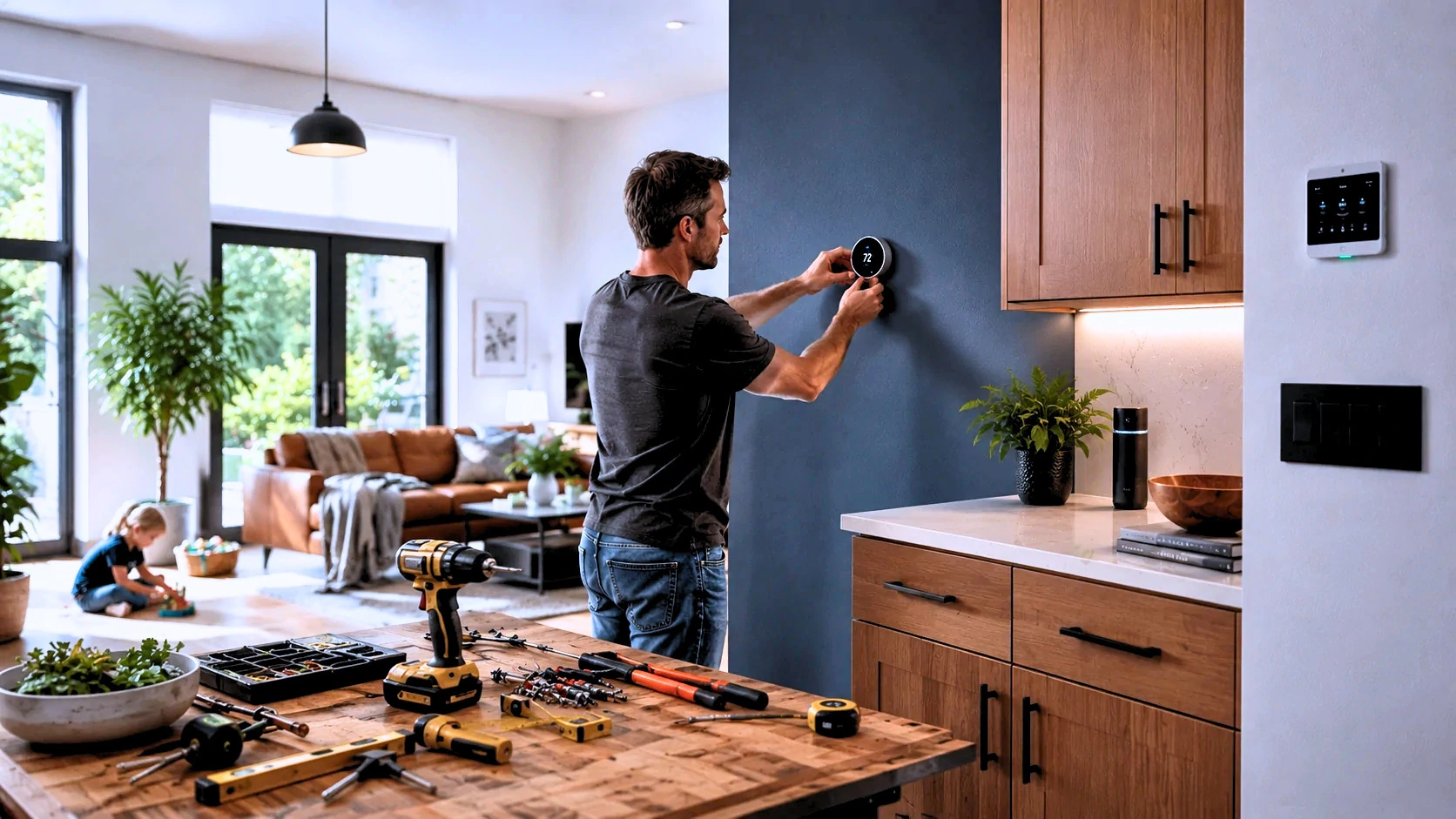
Can You Integrate a Central Vacuum with a Smart Home?
.webp)
Central vac is already more “smart” than most people realize — it just doesn’t advertise itself.
The hose-insertion auto-activation, the thermal overload protection, the bag-full indicator light on modern units — these are all automated responses built into the base system. No configuration required. The system already reacts to conditions and protects itself without any input from you.
What’s Already Automatic
- Motor auto-on/off via the hose insertion circuit — insert the hose, motor starts; remove it, motor stops
- Thermal overload protection — the motor shuts itself off if it runs too hot, then resets after cooling
- Bag-full indicator lights on most units manufactured after 2000 (check the face of the power unit)
Modern Central Vac Smart Features (2024–2026)
Some newer power units from Beam and NuTone include WiFi connectivity with companion app control, allowing you to monitor bag fill status, view runtime logs, and receive maintenance alerts on your phone. These are features on upper-end units — not something you’d typically find on an inherited system from 2005, but worth knowing if the topic of full replacement ever comes up.
For older inherited systems, smart home integration is possible but limited in practical upside:
Smart switch integration: A compatible smart outlet or relay switch wired to the power unit allows Alexa or Google Home to turn the unit on or off via voice command or automation. Since the motor only draws air when a hose is physically inserted at an inlet, voice activation mostly serves remote shutdown or as a home-automation trigger — not a hands-free vacuum experience.
Automated vacuum pans: Some kitchen renovation projects include a flush-mounted vacuum pan installed in the kickplate beneath base cabinetry. Stepping on the pan or pressing a button opens the vent and sweeps floor debris directly into the central system. These can be triggered by home automation routines for kitchens that already have central vac tubing nearby.
The honest take on smart integration: unless you’re already building out a whole-home automation system, the practical benefit over the existing auto-activation is genuinely minimal. It works, and it’s cool — but don’t buy a new power unit just for the app.
When It’s Time to Call a Professional (And When It’s Not)
Most issues are DIY. But there are two situations where you should not go it alone.
The dividing line is clear once you know it. Anything involving consumables (bags, filters), seals (gaskets, hose cuffs), or basic diagnostics (testing suction at inlets, locating blockages at the inlet end) is within reach for any homeowner comfortable with basic maintenance tasks. No special tools required.
Professional help is warranted for: motor work, ductwork clearing beyond the inlet valve, and electrical contact repair inside the inlet valve.
Troubleshooting Guide
| Symptom | Most Likely Cause | Fix | DIY? |
|---|---|---|---|
| No suction at all | Full bag, clogged filter, or unit not powered | Check bag/filter first; verify unit is on | ✅ Yes |
| Weak suction everywhere | Partial bag, worn filter, or small blockage | Replace bag; clean filter; test all inlets | ✅ Yes |
| Motor runs but no suction | Hose not sealing properly at inlet | Check hose cuff gasket; replace if cracked | ✅ Yes |
| Motor won’t start | Thermal overload tripped from overheating | Let unit rest 30–60 min, then retry | ✅ Yes |
| Inlet flap won’t open | Debris in hinge or spring broken | Clean debris; replace valve if spring failed | ✅ / ⚠️ |
| Burning smell during operation | Full bag or failing motor | Stop immediately; check bag; inspect motor | ⚠️ Pro |
| Unusually loud motor | Bearing wear or debris inside motor | Professional inspection | ⚠️ Pro |
| Electric contact not activating powerhead | Wiring issue at inlet or hose | Check hose wiring connection | ⚠️ Pro |
| Good suction at most inlets, not one | Localized tubing blockage | Try a clearing run; call duct specialist | ⚠️ Pro |
Finding the right technician: Not every appliance repair shop services central vacuums. HVAC technicians generally don’t either. Search specifically for “central vacuum service” or “built-in vacuum repair” — not just “vacuum repair shop.” In most metro areas, there are dedicated central vacuum service companies that handle everything from routine maintenance to full system replacement. They’re worth the extra effort to find.
Myth vs. Reality — What New Homeowners Get Wrong About Central Vacuums
Almost everything the internet tells you about central vacs is either outdated, oversimplified, or written by someone selling something. Let’s sort through the ones that come up most often.
| Myth | Reality |
|---|---|
| ”Central vacuums are outdated technology” | Modern units offer WiFi monitoring, HEPA filtration, and variable motor power. The form factor hasn’t changed much; the performance ceiling has risen considerably. |
| ”If it hasn’t been used in years, it’s probably broken” | Central vac motors are designed for longevity. 20–30 year lifespans are normal. More likely: full bag, clogged filter, or seized inlet gasket. |
| ”I need the original brand hose” | Many third-party hoses work with common inlet sizes. But you must verify port diameter and locking mechanism first — that’s where the compatibility mistake happens. |
| ”Central vacs are only for large homes” | Effective in homes from around 1,200 sq ft upward. Coverage depends on power unit strength and inlet placement, not home size category. |
| ”Exhaust air goes into the wall cavity” | Systems vent externally through the wall or a dedicated exhaust duct. Exhaust does not recirculate indoors under any normal operating condition. |
| ”Retrofitting a home without central vac is cheap” | New installations in existing homes cost $1,500–$3,000+. If your system is already there and working, you have a premium home feature most buyers specifically look for. |
Frequently Asked Questions
What is the spring-loaded flap near the floor in my house?
It’s a central vacuum system inlet valve. The round opening behind the flap connects to PVC tubing inside your walls, which runs to a power unit — usually in the garage or basement — that provides suction throughout the home. Inserting a compatible hose into the port activates the motor automatically.
How do I know if my central vacuum still works after buying a home?
Start by finding the power unit in the garage, basement, or utility closet, plugging it in, and turning it on. If you hear a clean motor hum without grinding or rattling, it’s likely functional. The next step is checking the collection bag — a full bag is the most common reason an otherwise working system loses suction. Start there before assuming anything is broken.
What does the small outlet inside the central vacuum inlet do?
It provides 120V power to an electric powerhead — a motorized brush attachment that connects through the hose to the inlet’s electrical contact. Not all inlets have this. Air-driven systems only have the suction port. If yours has the electrical contact or outlet, you can use a full electric powerhead kit for deep carpet cleaning.
Can I use any hose with a central vacuum inlet?
Not automatically. Hoses must match your inlet’s port diameter (1.5” or 2”) and locking mechanism style. The most common mistake new owners make is buying a hose without checking these two specifications first. Find the brand on your power unit before purchasing anything.
Where is the central vacuum power unit typically located?
In homes built between 1990 and 2010, it’s almost always in the garage (wall-mounted), a basement mechanical area, or a utility closet. Look for a cylindrical or rectangular unit roughly 18–24 inches tall, with a bag compartment at the bottom, a power cord, and an exhaust vent.
How long do central vacuum systems last?
Longer than most people expect. The motors routinely last 20–30 years with basic maintenance. If your home was built in 2005 and the system was used occasionally, it likely has a decade or more of useful life remaining. Age alone is not a reason to replace it.
Is it worth buying accessories for an inherited central vacuum?
In most cases, yes. A basic hose and attachment kit ($60–$150) unlocks 3–5x more suction than a comparable portable vacuum. If the power unit tests functional, that’s the lowest-cost vacuum upgrade available to you. The question isn’t really whether to buy accessories — it’s whether your system is functional enough to justify them, which the first-check checklist above will tell you.
My central vacuum runs but has weak suction — what’s wrong?
Start with the bag — an overfull bag causes near-complete suction loss even when the motor runs perfectly. Then check the secondary filter. If both are fine, inspect the hose cuff gasket for cracks — air leaks at the hose connection are a very common source of lost suction that’s easy to miss. If suction is strong at some inlets but weak at one specific location, there may be a blockage in the tubing serving that inlet.
Can I connect my central vacuum to a smart home system?
Yes, with some limitations. Newer power units from Beam and NuTone include WiFi control and app monitoring. For older systems, adding a smart outlet or relay switch to the power unit allows basic Alexa or Google Home voice commands. The practical upside over the system’s existing auto-activation is limited for most setups — worth doing if you’re already building out smart home infrastructure, not worth a power unit upgrade on its own.
Should I replace or repair an old central vacuum system?
If the motor runs cleanly and the tubing is intact, repair is almost always the better value. Replacing the bag, filter, and buying a hose kit costs under $200 total and gives you a fully operational system. Full replacement makes most sense when the motor has failed and the unit is 25+ years old with no available replacement motor — at that point, the economics of a new system become reasonable.
The Bottom Line for New Homeowners
There’s a moment — usually about an hour into researching that wall port — when most new homeowners realize they’ve stumbled into something unexpectedly useful.
Central vacuum systems aren’t glamorous. They don’t get YouTube reviews or influencer unboxings. They’re just a functional piece of home infrastructure that was installed by a builder, forgotten about by the previous owners, and left for you to figure out. Which, it turns out, doesn’t take long at all.
If the power unit tests functional — and statistically, it probably does — you have a whole-home vacuum system that outperforms most retail options under $500. The first step is knowing what you have. The second is the 30-minute diagnostic process above. After that, a $100 accessory purchase gets you running.
That’s not a bad situation to be in.
*Related reading: *
.webp)



.webp)