.webp)
Quick answer: Basic home maintenance means regularly inspecting and servicing your home’s core systems — HVAC, plumbing, roof, electrical, and exterior — on a seasonal schedule. Done consistently, it prevents the kind of expensive failures that catch most homeowners completely off guard.
At a glance:
- Replace HVAC filters every 1–3 months
- Clean gutters at least twice a year
- Test smoke and CO detectors every six months
- Service your water heater annually
- Budget 1–2% of your home’s value per year for maintenance
- Seasonal checklists can reduce emergency repair costs by 30–50%
Why Basic Home Maintenance Gets Skipped (And Why That’s a Costly Mistake)
Here’s something no one warns you about when you buy a house: the maintenance doesn’t announce itself. A slow gutter clog doesn’t sound an alarm. A failing water heater anode rod doesn’t send you a reminder. And by the time you notice something’s wrong — the water stain on the ceiling, the unusually high energy bill, the sudden furnace failure in January — you’re already past the point where a $40 fix would have worked.
Most homeowners skip maintenance for three reasons: they don’t know what to do, they don’t know when to do it, or they assume everything’s fine because nothing has visibly broken yet. All three are completely understandable. But they’re also how a $200 gutter cleaning turns into a $4,000 foundation repair.
This guide fixes that. It’s a practical, honest resource — not a checklist you’ll print and forget, but a framework you can actually use.
.webp)
The Real Numbers: What Deferred Maintenance Costs Homeowners
The 1% rule is the most common benchmark in home maintenance budgeting: expect to spend roughly 1% of your home’s purchase price on maintenance each year. A $400,000 home? Budget around $4,000 annually.
That sounds like a lot until you price out what deferred maintenance actually costs:
| Neglected Task | DIY Prevention Cost | Repair Cost When It Fails |
|---|---|---|
| Gutter cleaning | $0–$150/year | $1,500–$10,000 (water damage, foundation) |
| HVAC filter changes | $10–$40/year | $300–$1,200 (coil replacement, efficiency loss) |
| Water heater flush | $0 DIY | $800–$1,500 (premature replacement) |
| Caulking windows/doors | $10–$30 | $200–$800 (water intrusion, rot) |
| Roof inspection | $0–$200 | $5,000–$15,000+ (full replacement) |
| Sump pump test | $0 | $2,000–$10,000 (basement flooding) |
The pattern is consistent: the tasks that cost almost nothing to maintain reliably produce the most expensive failures when ignored.
How Smart Home Tech Changes the Maintenance Game
Smart home devices won’t do your maintenance for you — but they can make it dramatically harder to forget.
A smart thermostat like a Nest or Ecobee tracks filter runtime and sends reminders when it’s time to swap. Leak sensors placed under sinks, near the water heater, and behind the washing machine catch slow drips before they become floods. Smart smoke and CO detectors log self-test results and notify you when batteries need replacing.
The honest trade-off: these devices add cost upfront and require their own occasional maintenance (firmware updates, battery checks). But for households where “I forgot” is the most common reason maintenance gets skipped, they earn their keep quickly.
One caveat worth flagging: no sensor replaces a physical walkthrough. A leak detector under your kitchen sink won’t catch a slow roof leak working its way through your attic insulation. Tech augments attention — it doesn’t replace it.
The Complete Seasonal Home Maintenance Checklist
Organizing maintenance by season isn’t just a formatting choice — it’s how the work actually flows. Your gutters need clearing after leaves fall, not in July. Your HVAC system should be inspected before you need it, not the day temperatures drop.
.webp)
Spring Home Maintenance Tasks
Spring is your assessment season. You’re looking for damage winter left behind and preparing for summer heat and rain.
Exterior checks:
- Inspect roof for missing, cracked, or curled shingles — binoculars from the ground work for most homeowners
- Check gutters and downspouts for debris, sags, or separation from fascia
- Look at exterior caulking around windows, doors, and where siding meets trim — winter freeze/thaw cycles crack it reliably
- Walk the perimeter and look for foundation cracks, soil erosion, or areas where water pools near the house
Interior and systems:
- Schedule your HVAC tune-up before summer demand makes appointments scarce
- Replace the HVAC filter if you haven’t since fall
- Test all smoke and CO detectors (replace batteries if needed; replace the unit if it’s more than 10 years old)
- Check the water heater for corrosion, rust-colored water, or rumbling noises during heating — signs sediment has built up
- Turn on exterior hose bibs slowly and check for drips that suggest freeze damage
Outdoor prep:
- Check deck or patio for loose boards, popped nails, or soft wood that indicates rot
- Reconnect and test any irrigation or sprinkler systems
- Trim back any branches overhanging the roof
Summer Home Maintenance Tasks
Summer is your upkeep season. Less emergency work, more optimization and prevention.
- Clean dryer vent thoroughly — lint buildup is a genuine fire hazard and a leading cause of reduced dryer efficiency
- Inspect and clean bathroom exhaust fans (they accumulate lint and dust faster than most people expect)
- Check attic ventilation — poor airflow in summer drives up cooling costs significantly
- Test the sump pump if you have one: pour water into the pit and confirm the float triggers the pump
- Inspect window and door screens; patch or replace any that have gaps or tears
- Service lawn equipment while you have time (rather than scrambling before the first mow)
- Check the exterior of your home’s air conditioning unit — clear any plant growth or debris from around the condenser
Fall Home Maintenance Tasks
Fall is your most critical maintenance season. What you do here determines how your home handles winter.
Heating system prep:
- Schedule furnace or boiler service if you haven’t done it in a year
- Bleed radiators if you have a hot-water heating system (trapped air causes cold spots)
- Stock up on HVAC filters so you’re not scrambling mid-winter
Weatherproofing:
- Inspect and replace weatherstripping on exterior doors — hold a piece of paper in the closed door; if it slides out easily, you’re losing heat
- Caulk around windows where any gaps or cracks appeared since spring
- Check attic insulation levels; adding insulation is one of the highest-ROI home improvements available
Exterior winterization:
- Clean gutters after the last leaves fall — this is non-negotiable in most of North America and the UK
- Drain and store garden hoses; shut off exterior hose bib valves inside the house
- Check the roof one more time before heavy snow arrives
- Inspect chimney and fireplace if you use it (annual professional inspection recommended)
Safety systems:
- Test smoke and CO detectors again (second of the twice-yearly checks)
- Check fire extinguisher pressure gauge
Winter Home Maintenance Tasks
Winter is your monitoring season — most major prep should be done. Focus on watching for problems and managing systems under load.
- Monitor for ice dams forming at roof edges (signs: icicles larger than normal, water stains appearing on interior ceilings)
- Keep attic temperature regulated — a warm attic causes snow to melt, refreeze at the eaves, and back up under shingles
- Check that dryer, bathroom, and kitchen exhaust vents remain clear of snow or ice blockages
- Run water in infrequently used sinks and tubs during cold snaps to prevent pipe freezing
- Know where your main water shutoff valve is — in a burst pipe scenario, every second counts
- Check basement and crawl space for condensation or moisture during heavy rain or snowmelt
Room-by-Room Maintenance Guide
A seasonal checklist covers most of what you need. But it’s easy to overlook specific rooms during a quick walkthrough. This section gives you a focused lens for each area.
Kitchen Maintenance Checklist
The kitchen has more mechanical systems per square foot than anywhere else in the house.
- Refrigerator coils: Clean underneath and behind your fridge annually. Dusty coils make the compressor work harder and shorten the appliance’s life. A coil brush costs $10 and takes five minutes.
- Dishwasher filter: Most people don’t know their dishwasher has a filter — check your manual and clean it every few months
- Range hood grease filter: Soak it in hot water and degreaser monthly if you cook frequently
- Garbage disposal: Run it with cold water and a few ice cubes occasionally to clean the blades; check under the sink monthly for any drips from the P-trap
- Supply lines: Check the braided lines running to the fridge icemaker, dishwasher, and sink faucets. Aged rubber lines are a common source of slow, invisible leaks.
Bathroom Maintenance Checklist
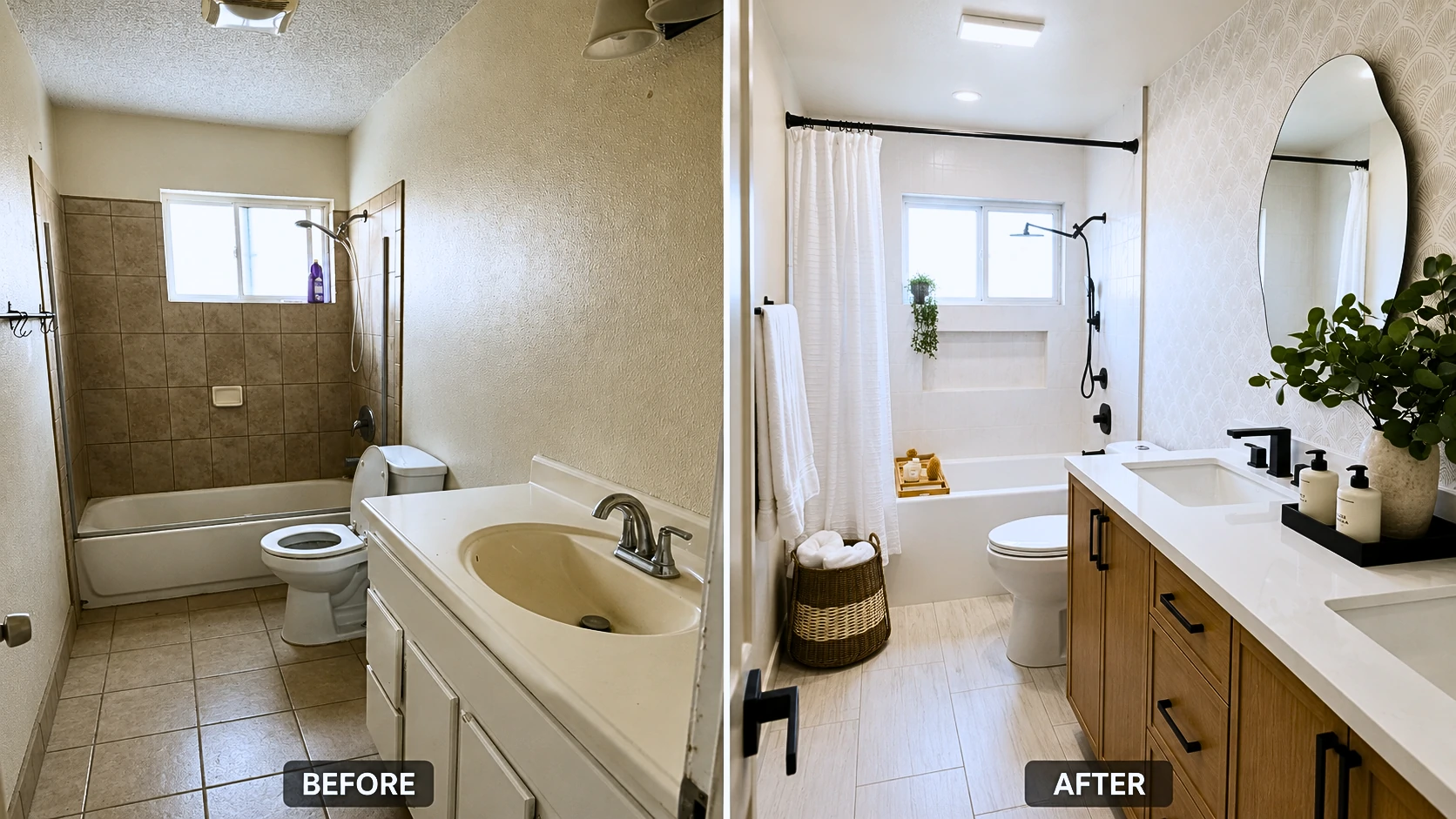
Moisture is the defining challenge in every bathroom. Your maintenance focus here is preventing water damage before it starts.
- Caulk and grout: Inspect the caulk line where the tub or shower meets tile or the surround panel. Any gaps or discoloration that doesn’t clean off signals water is getting behind the wall — address it immediately.
- Toilet innards: Lift the tank lid and check the flapper and fill valve periodically. A running toilet can waste 200 gallons of water per day — and it often sounds like silence.
- Exhaust fan: Run it during every shower and leave it running for 10–15 minutes after. If the fan doesn’t clear steam within a few minutes of use, it’s undersized or clogged.
- Supply line under the sink: Check for mineral deposits or corrosion where the supply line meets the shutoff valve.
- Shower drain: Clean hair and debris monthly to prevent slow drainage that backs up and tests your caulk lines.
Basement and Attic Checks
Both spaces tend to be out of sight and out of mind — which is exactly why problems there get expensive.
Basement:
- Look for new cracks in the foundation wall — hairline cracks are common; horizontal cracks or ones wider than 1/4 inch warrant a professional opinion
- Check for any white chalky residue (efflorescence) on concrete walls, which indicates water is moving through the masonry
- Inspect sump pump and pit quarterly
- Check exposed pipes for condensation or dripping during humid months
Attic:
- Look for daylight where there shouldn’t be any (around vents, at the ridge)
- Check insulation for compression, moisture damage, or gaps
- Look at rafters for dark staining, which can indicate past or current moisture intrusion
- Make sure bath and kitchen exhaust vents exit fully outside — improperly terminated vents that dump humid air into the attic are a surprisingly common source of mold problems
HVAC Maintenance: The System Most Homeowners Neglect
Of every home system, HVAC is the one that takes the longest to visibly fail and causes the most financial damage when it does. A slow decline in efficiency is easy to miss — until you compare your energy bills to two years ago and realize you’ve been spending $30–$50 a month extra for a problem a $15 filter change would have prevented.
.webp)
How Often to Change Your Air Filter (And Which Type to Buy)
The answer most homeowners get wrong: not every three months across the board.
| Household Type | Recommended Filter Change Interval |
|---|---|
| Single person, no pets, no allergies | Every 6–12 months |
| Average family home | Every 90 days |
| One pet in the home | Every 60 days |
| Multiple pets or allergy sufferers | Every 30–45 days |
| High-dust environments (near construction, gravel roads) | Every 30 days |
Which filter to buy? The MERV rating (Minimum Efficiency Reporting Value) is what matters.
- MERV 1–4: Basic fiberglass filters. Protect the HVAC equipment but do essentially nothing for air quality.
- MERV 8–10: The sweet spot for most homes. Captures dust, pollen, mold spores, and pet dander without restricting airflow.
- MERV 11–13: Good for allergy sufferers. Verify your system can handle the added restriction before upgrading.
- MERV 14+: Hospital-grade. Most residential systems aren’t designed for this level of restriction — using them without verifying compatibility can damage your blower motor.
Smart HVAC filters with built-in sensors that track usage and alert you via app are worth considering if you have a history of forgetting. They’re a modest upgrade that solves a consistent human problem.
Annual HVAC Service: DIY vs Calling a Tech
What you can do yourself:
- Change filters on schedule
- Clear 2 feet of clearance around the outdoor condenser unit
- Straighten bent fins on the condenser (a fin comb costs $10)
- Clean the condensate drain line with diluted bleach annually
- Change batteries in the thermostat
What warrants a professional:
- Annual tune-up (cleaning coils, checking refrigerant levels, testing electrical connections, lubricating motors)
- Any unusual noises — grinding, squealing, or banging aren’t “it’ll probably go away” situations
- Repeated cycling on and off without reaching set temperature
- Refrigerant issues — handling refrigerant requires EPA certification and is never a DIY task
The typical HVAC annual service runs $80–$150 in most US markets, $60–$120 in the UK, and similar ranges in Canada and Australia. It’s one of the better-value professional services you can buy — a tech who spots a failing capacitor during a tune-up saves you from a full no-cool emergency in August.
Plumbing Maintenance Tasks Every Homeowner Can Handle
.webp)
Most plumbing maintenance isn’t plumbing — it’s observation. The goal is catching the early signs before they become emergencies.
Monthly:
- Run water in any sink, shower, or tub you don’t use regularly; P-traps dry out and allow sewer gas into the home
- Check under kitchen and bathroom sinks for drips or moisture
Every 6 months:
- Test every shutoff valve under sinks and behind toilets by turning them off and back on; valves that seize open are worthless in an emergency
- Inspect washing machine hoses — braided stainless is worth the upgrade if yours are rubber and older than five years
- Pour a gallon of water into floor drains to keep P-traps filled
Annually:
- Water heater flush: Connect a garden hose to the drain valve at the base of the tank, run it outside or to a floor drain, and flush until the water runs clear. This removes sediment that reduces efficiency and accelerates corrosion. On tankless heaters, annual descaling is the equivalent task.
- Anode rod inspection: This is the one most homeowners have never heard of. The anode rod is a sacrificial metal rod inside your water heater that corrodes so the tank doesn’t. When it’s depleted, the tank starts corroding instead — and replacement is simply a new water heater. Inspect the anode rod every three years; replace it if more than 50% is depleted. This single task can double the life of a water heater.
- Check the pressure relief valve on your water heater — it should lift and release easily
⚠️ Safety note: Never work on gas lines yourself. A licensed plumber or gas fitter handles anything involving gas connections, even if the task looks simple. The consequences of an error are severe and immediate.
Roof and Exterior: What to Look For (Without Getting on the Roof)
The good news: you can assess most roofing issues from the ground with a decent pair of binoculars. The better news: catching problems early dramatically narrows your repair options from “full replacement” to “spot repair.”
.webp)
What to look for from the ground:
- Missing shingles or shingles that look raised, curled at the edges, or darker in patches (signs of moisture absorption)
- Granules accumulating in gutters — some granule loss is normal, but heavy accumulation signals aging shingles
- Sagging anywhere along the roofline — this indicates structural issues beneath the surface
- Flashing around chimneys, vents, and skylights that looks lifted, bent, or separated
Gutters: Clean them in late fall and again in spring. A gutter full of debris does far more damage than most homeowners realize — water backs up, sits against the fascia board, soaks into the roof deck, and eventually finds its way inside. In colder climates, packed gutters cause ice dams.
Exterior caulking and paint: Inspect every joint where different materials meet — wood siding to trim, trim to window frames, around any penetrations (pipes, vents, electrical boxes). Failed caulk is the single most common entry point for water intrusion in older homes.
Home Maintenance Cost Guide: What to Budget Per Year
The 1% rule is a starting point, but it skews depending on your home’s age, size, and condition. A newer home with a warranty may cost far less in the early years. A 40-year-old home with original systems may run closer to 2–3%.
.webp)
Here’s a realistic breakdown of annual maintenance costs by task:
| Task | DIY Cost | Professional Cost | Frequency |
|---|---|---|---|
| HVAC filter changes | $40–$120 | N/A | Monthly–quarterly |
| HVAC annual service | N/A | $80–$150 | Annually |
| Gutter cleaning | $0–$50 (own ladder) | $100–$250 | 2x/year |
| Water heater flush | $0 | $80–$120 | Annually |
| Dryer vent cleaning | $0–$30 | $80–$150 | Annually |
| Smoke detector batteries | $10–$20 | N/A | Annually |
| Window/door caulking | $10–$30 | $150–$400 | Every 2–5 years |
| Roof inspection | $0 (DIY ground check) | $150–$300 | Annually |
| Chimney cleaning | N/A | $150–$250 | Annually (if used) |
| Pest inspection | N/A | $75–$150 | Annually |
Rough annual total for a median US home (DIY-leaning): $500–$1,500 Fully professional maintenance: $2,000–$4,000+
These numbers cover routine maintenance only — not repairs, not replacements, not emergencies.
DIY vs Hiring a Pro: How to Decide
The most common mistake homeowners make isn’t attempting too much DIY — it’s attempting the wrong tasks.
| Task | DIY? | Why |
|---|---|---|
| HVAC filter changes | ✅ Yes | No tools or expertise required |
| Gutter cleaning | ✅ Yes (with ladder safety) | Straightforward; equipment is minimal |
| Caulking windows | ✅ Yes | Low stakes; easy to correct errors |
| Water heater flush | ✅ Yes | Standard DIY with basic instructions |
| HVAC tune-up | ❌ Pro | Refrigerant, electrical, and calibration work |
| Roof repairs | ❌ Pro | Fall risk; improper repairs accelerate damage |
| Electrical panel work | ❌ Pro | Safety-critical; often requires permit |
| Gas line connections | ❌ Pro | Always. No exceptions. |
| Foundation repair | ❌ Pro | Structural; incorrect repair makes things worse |
| Chimney repointing | ❌ Pro | Requires specialized technique and materials |
The general framework: if the task involves working at height, involves gas or electrical systems, requires a permit, or could make the problem worse if done incorrectly — call a licensed professional.
Common Home Maintenance Myths (And What’s Actually True)
Myth: “If it ain’t broke, don’t fix it.” Reality: Most home systems fail slowly, invisibly. By the time something is visibly broken, the damage is usually already done. A water heater doesn’t just stop working — it corrodes from the inside for years first.
Myth: “Smart home devices make maintenance mostly automatic.” Reality: Connected devices help with reminders and monitoring, but they don’t replace physical inspection. A leak sensor under your sink doesn’t check your roof. They’re useful tools, not a maintenance program on their own.
Myth: “New construction homes don’t need maintenance for the first few years.” Reality: New homes often have settling cracks, caulking failures, and grading issues in the first few years that are easier to address early. The systems may be new, but they still need regular attention.
Myth: “Annual professional inspections are overkill.” Reality: A single professional inspection can catch issues a homeowner would never identify — and often pays for itself with one prevented repair.
Myth: “I’ll do it when I notice a problem.” Reality: The most expensive home repairs are the ones that didn’t show themselves until they were severe. Waiting for visible problems is the most expensive maintenance strategy available.
Frequently Asked Questions
How much should I budget for home maintenance per year?
The standard benchmark is 1–2% of your home’s value annually. A $350,000 home should have roughly $3,500–$7,000 budgeted for maintenance and minor repairs each year. Older homes, homes with original systems, and homes in harsh climates trend toward the higher end.
What is the 1% rule for home maintenance?
The 1% rule suggests budgeting 1% of your home’s purchase price per year for maintenance costs. It’s a rough guideline rather than a precise formula — the real variables are your home’s age, construction quality, location, and how consistently you’ve maintained it in prior years.
What home maintenance can I do myself vs call a professional?
As a general rule: anything that doesn’t involve height, gas, structural elements, or the electrical panel is a reasonable DIY candidate with proper research. HVAC filter changes, caulking, gutter cleaning, minor drywall patching, and fixture replacement are typically accessible. Anything involving the roof, electrical panel, gas lines, foundation, or HVAC refrigerant should go to a licensed pro.
How often should you get your house inspected?
Most home inspectors and building professionals recommend a full home inspection every three to five years, particularly for older homes. Annual professional checks on specific systems — HVAC, chimney, roof — make sense on their own schedule. A pre-sale inspection is always worth commissioning before listing a home.
Why is my energy bill high even with a smart thermostat?
A smart thermostat optimizes your heating and cooling schedule, but it can’t compensate for underlying inefficiencies. The most common culprits are a dirty HVAC filter restricting airflow, poor attic insulation allowing heat transfer, failing window seals, or an aging HVAC system losing efficiency. Use your thermostat’s energy reports as a diagnostic tool — sudden increases in runtime often signal a maintenance issue rather than a thermostat problem.
What maintenance does a new homeowner need to do in the first year?
Start by understanding your home’s systems: locate the main water shutoff, the electrical panel, the furnace, and any cleanouts. Complete a full seasonal inspection cycle to establish a baseline. Service the HVAC, flush the water heater, clean gutters, test all safety devices, and note the age of every major appliance. You’re not just doing maintenance — you’re learning what you own.
Can skipping maintenance void my home insurance?
Yes — and this is significantly underreported. Most homeowner policies include a “neglect” clause that can void coverage for damage directly attributable to deferred maintenance. A roof leak that’s been ignored for two years is unlikely to be covered if the insurer’s adjuster determines the damage was preventable. Keeping records of your maintenance activities provides meaningful protection here.
What smart home devices actually help with home maintenance?
The most practical options by impact:
- Smart water leak detectors (under sinks, near water heater, washing machine): catch slow leaks before they cause structural damage
- Smart thermostat (Nest, Ecobee): filter change reminders, runtime tracking, energy reporting
- Smart smoke and CO detectors: self-testing, app alerts, interconnected alarm coverage
- Home energy monitor (Emporia Vue, Sense): identifies efficiency losses and unusual consumption patterns
- Smart water shutoff valve: automatically shuts off water in a leak event — high value for vacation homes or anyone frequently traveling
None of these replace maintenance; all of them make it easier to stay ahead of problems.
Last updated: 2026. Costs reflect US market averages; UK, Canadian, and Australian pricing will vary by region and market conditions.
.webp)
.webp)
.webp)
.webp)
.webp)